During the second half of the last century our knowledge about letters and other manuscripts written by Maria Sibylla Merian has steadily increased. Of course, the rediscovery and publication of her Book of Notes and Studies in 1976 (Leningrader Studienbuch) is a most important landmark in Merian research. However, our knowledge about her correspondence has grown rather slowly.
Up to the present, only eighteen letters have been traced. In 1944, Jantje Stuldreher-Nienhuis published four letters written to Clara Regina Imhoff in Nuremberg in the years 1683-1697. Later on, in 1967, Elisabeth Rücker published six more letters, addressed to Merian’s friend and pupil Clara Regina and to Johann Georg Volkamer in Nuremberg and written in 1682, 1685, 1702, 1704 and 1705 (of one other letter written in 1702 the adressee is unknown). In 1980, Elisabeth Rücker and William T. Stearn added seven more letters, all addressed to the apothecary James Petiver in London, written in the years 1703-1712. For transcriptions of all hitherto known letters written by Maria Sibylla Merian, see the overview on this website under ‘Sources’-‘Letters’.
Discovery of the last Merian letter
As early as 1961, the great Dutch art collector Frits Lugt (1884-1970) bought an as yet unknown letter written by Merian in 1711, addressed to the historian and numismatist Christian Schlegel (1667-1722) in Arnstadt. The letter is still kept in the art historical study centre Fondation Custodia in Paris, founded by Frits Lugt.1 It remained for a long time unnoticed, until a photocopy of the letter was passed on to me after a successful cooperation between the Artis Library and the Fondation Custodia in 1983, when both institutions contributed to a large Merian exhibition in the Rosenborg Castle in Copenhagen.2 I read the letter immediately and then I felt very lucky, as its contents seemed to be fairly important. It is a business letter in which she gives the prices of her published works: uncoloured, coloured regular copy, and coloured counterproof copy. After seeing this letter, I looked out for a good opportunity to make it public.
The best occasion was of course Merian’s 350th birthday in April 1997, so I had to keep it secret for a long while – and “patientia is a good little herb” as Maria Sibylla wrote in her letter to Johann Georg Volckamer at the end of July 1704 (letter 13). Finally, when Kurt Wettengl visited the Artis Library to arrange various loans for his large Merian exhibition in Frankfurt am Main in 1997, I told him my secret and he was very enthusiastic about it. Of course he wished to publish the letter in his catalogue and thus the catalogue contains transcriptions of all eighteen hitherto known letters written by Merian.3 In Amsterdam festivities were organized on the occasion of Merian’s birthday as well: for instance, the elocutionist Corien Barneveld recited parts of the long poem on Merian by Bertus Aafjes4 in the Royal Hall of the Zoological Society Natura Artis Magistra, accompanied by baroque music. Later that April, I enjoyed giving a talk in commemoration of the 350th anniversary of Merian’s birth at the University of Virginia in Charlottesville, USA. I presented the letter written in 1711, gave a translation and discussed its contents. It was a preliminary talk on the eve of the international conference “The natural bridge – the transatlantic exchange” organized by the Society for the History of Natural History. That talk was later remodeled into an article, co-authored by Diny Winthagen, and published in the Society’s journal Archives of Natural History in 1999. The article contained a good photographic copy of the original manuscript.5
An important error in the transcription
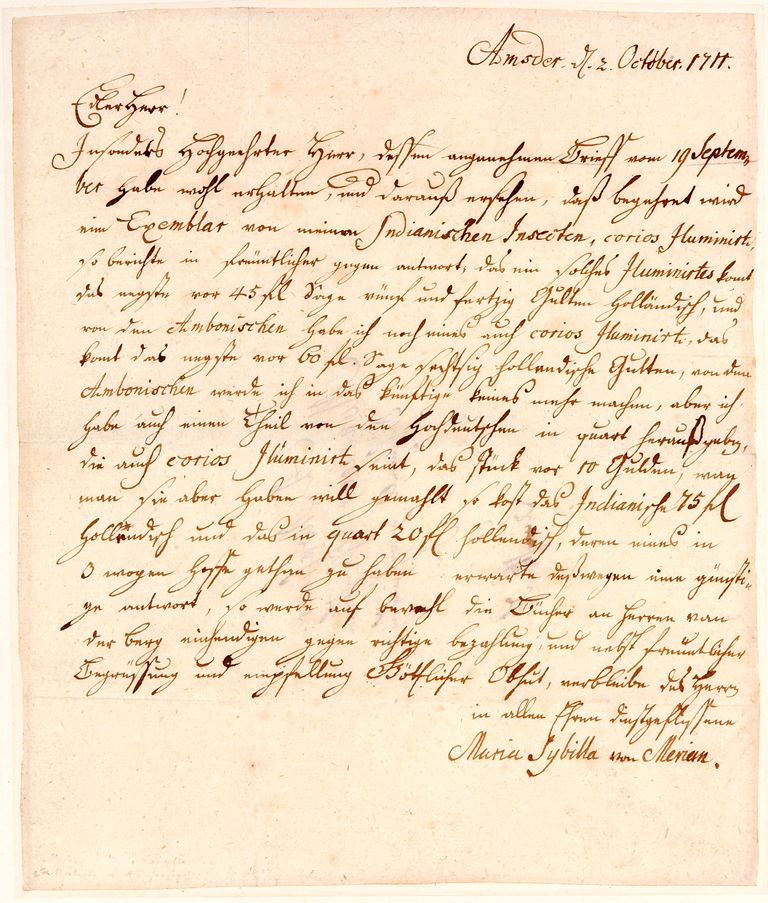
Later I sent reprints to my Merian friends, including Brigitte Wirth in Göttingen. From her article published in 2007 I knew that she is very good and precise in transcribing letters.6 In her reply she pointed to a transcription error: instead of “in & erwogen” (which does not make sense) it should read: “in 3 wogen”, meaning “within three weeks”. This meaning is also missing in Elisabeth Rücker’s transcription in Wettengl’s catalogue. The correct transcription of this letter (letter 17) can be found here on the Society website, wherein all transcriptions have been carefully checked by Brigitte Wirth.
Why is the precise transcription of this phrase so important? It concerns the colouring of two parts of the caterpillar book, in counterproof, for the price of 20 Dutch guilders “deren eines in 3 wogen hoffe gethan zu haben”, translated: “of which I hope to have done one within 3 weeks”. So this gives us some information about the amount of time required to execute such colouring in her workshop.
Presently I can thus give the correct translation of the letter (cf. Figs. 1 and 2):
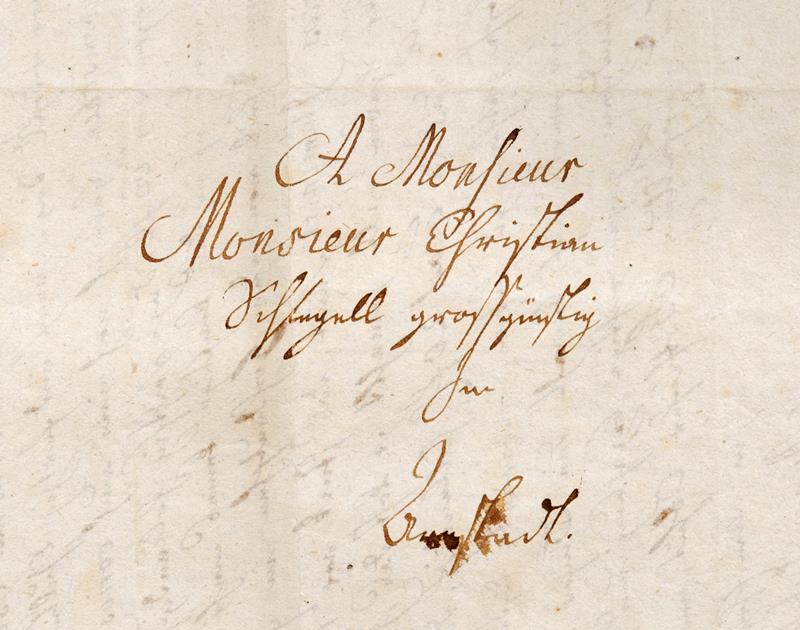
Monsieur the generous Gentleman
Mr Christian Schlegell [sic]
in
Arnstadt
Amster[dam], October 2nd 1711
My Lord!
With regard, most esteemed Sir, to your kind letter of September 19th,
which was received in good condition and from which is understood that you wish to have
a copy of my Indian Insects, curiously illuminated,
I kindly reply that such an illuminated copy may now be obtained
at the price of 45 florins, verbally forty-five Dutch guilders, and
from the Ambon [book] I still have one copy left, also curiously illuminated, which
can be had for 60 fl, verbally sixty Dutch guilders. From the
Ambon [book] I will not make more copies, but I
also [have available] a volume I have published in High German in a quarto edition,
curiously illuminated too, 10 guilders a volume. When,
however, one wants them painted, the Indian [book] [amounts to] 75 fl
Dutch and the quarto [work] 20 fl Dutch, either of which I
hope to have done within 3 weeks, therefore expect a favour-
able reply, so that, if indeed required, the books may be delivered to Mister van
der Berg against proper payment. Concluding with friendly
greetings and commended with God’s blessing, [I] remain faithfully my lord’s
dedicated servant
Maria Sybilla von Merian [sic]
Interpreting Merian’s letter
(1) With “a copy of my Indian insects” she means her Metamorphosis Insectorum Surinamensium, published in 1705, and with “a volume I have published in High German in a quarto edition” she is referring to her two Raupen books on European caterpillars published in 1679 and 1683. Please note that she writes “my Indian insects” and “a volume I have published”.
(2) With the Ambon book she means G.E. Rumphius’s D’Amboinsche Rariteitkamer, (“The Ambonese Curiosity Cabinet”), published for the first time in the same year (1705) as her Metamorphosis Insectorum Surinamensium. Rumphius’s book contains little original work by M.S. Merian, while several other artists are known who made original work for the engravings in the book (see below). This also explains why she indicates the book as the Ambon book, not as my Ambon book. However, handcoloured copies of Rumphius’s book could be ordered from her workshop, of which at least one copy is known.7 As to the Rumphius book, she seems to have been mainly concerned with colouring the plates.
(3) She writes “From the Ambon [book] I will not make more copies”. This seems logical, because the copperplates were no longer available to her at the time, since in the same year 1711 the so-called Latin edition of Rumphius’s book was published in Leiden.8
(4) “Curiously illuminated” means with nicely handcoloured engravings and with “painted” she means handcoloured counterproof copies.9 In her workshop also one complete set of the plates for Rumphius’s book was copied on parchment, just as was done with three copies of Metamorphosis.10 These drawings made up part of a set of about 200 large drawings on parchment that were bought for Czar Peter the Great, which are still present in the library of the Russian Academy of Sciences in St. Petersburg.11 Please note that these so-called “Rumphius drawings on vellum” contain but few original work by Maria Sibylla Merian, though these gouaches have been painted in her workshop!12
(5) She used her own press for printing the plates for her own books, printing plainly or in counterproof.13 After ordering, hand-coloured books in counterproof could be delivered within three weeks.
(6) The prices for her books, though expensive, hardly changed during her lifetime. It is also clear that the coloured counterproof copies were mostly made on demand.
(7) She signs as Maria Sibylla von Merian. Probably the letter was addressed to her with this noble name and she thought this was good publicity. Her nephew Johann Mathaeus von Merian (1659-1716), son of Maria Sibylla’s half-brother Matthaeus Merian the Younger (1621-1687), was likewise a famous painter and engraver, just as his father and grandfather. He continued the illustrious Merian firm and eventually was even raised to nobility, hence his name was expanded by adding “von”.
More about Merian’s work for Rumphius’s book
Let us now have a closer look at the plates in Rumphius’s book. On plate XXXIV (Fig. 3), the editor Simon Schijnvoet (1652-1727) wished to show the rarest and most beautiful cone shells to the collectors, adding several shells occurring outside Ambonese waters. By doing so, Schijnvoet wanted to make the book more attractive to shell collectors in general. The cone shell shown as nr. A on this plate is the Orange Admiral, Conus aurisiacus L. 1758, according to Simon Schijnvoet “Of all that comes from the Sea, especially the Toots, this is the most beautiful Whelk I know. The honourable Mr. D’Aquet, Mayor of Delft, who is often mentioned here, is the only one who owns one, and no other is known anywhere else.”14
This shell could have been drawn by Maria Sibylla from the only specimen known at the time, owned by Hendrik d’Acquet (1632-1706), a friend of Rumphius who received many original specimens as well as the original manuscript of the book from him. The original drawing for the book does not occur in the so-called d’Acquet Atlas15, though it can be found unsigned and uncoloured in an album once owned by Schijnvoet, entitled Dessins originaux des Raretés d’Amboine par G: E: Rumphius in the Royal Library in The Hague.16 However, Merian certainly did not make all these drawings, as two of these are signed by Pieter de Ruyter, Rumphius’s collaborator at Ambon, while the “rock crab” on plate IX, likewise from d’Acquet’s collection, is signed “J: Lamsveld: del: fec.”, so this crab has been drawn as well as engraved by Jan Lamsveld (1673-1743 or later). Moreover, several of the most beautiful shells in the book could neither be traced to the Schijnvoet album, nor to the d’Acquet Atlas.
Accidentally, I discovered that the magnificent imperial cone shell Conus imperialis in the upper center (H) is an exact copy of an etching by the famous artist Wenceslaus Hollar (1607-1677; see Fig. 4). That is also the reason why this is the only shell on the plate that is correctly figured as right-coiled. All the other shells on this plate are incorrectly figured as being left-winded, representing their mirror image – a rare occurrence in nature and certainly the result of printing from an engraved image. If a counterproof is made from a still wet print of this plate, all shells except the imperial cone would be correctly figured as RIGHT-coiled. The Artis Library owns such a coloured counterproof copy of Rumphius’s book, as well as a “regularly” coloured copy, said to be coloured by Merian herself.17
Seven more copies after etchings of shells by Hollar can be found in Rumphius’s book.18 Now it is clear why Merian is not separately mentioned as artist for the book, as none of the artists are mentioned – only the engravers have signed their engraved plates.19 In my opinion, the set of “Rumphius drawings” by Merian in the Academy of Sciences in St. Petersburg20 consists of beautifully coloured drawings on parchment, mostly copied from the engravings after publication. I am looking forward to continue the discussion about Merian’s participation in Rumphius’s book at the Merian conference in June 2017.
Conclusions
(1) When publishing important manuscripts that are difficult to transcribe, it is advisable to publish facsimiles of the written text along with the transcription. This is for instance very well achieved in the facsimile of Merian’s Studienbuch.21
(2) Transcription of old manuscripts should be teamwork.
(3) Merian’s participation in the preparation and production of the plates in Rumphius’s book is questionable.
References
Aafjes, B., [1946]. Maria Sibylla Merian. Amsterdam.
Beekman, E.M., 1999. The Ambonese Curiosity Cabinet – Georgius Everhardus Rumphius; translated, edited, annotated, and with an introduction by E.M. Beekman. New Haven & London.
Benthem Jutting, W.S.S. van, 1959. Rumphius and malacology. In: H.C.D. de Wit (Ed.), Rumphius Memorial Volume: 181-207, pls. 17-22. Baarn.
Klein, A. & N. Klomp, 1983. Maria Sibylla Merian (1647-1717). [Catalogue of an exhibition in Schloss Rosenborg]. København.
[Merian, M.S.] Gräffinn, M.S., 1679. Der Raupen wunderbare Verwandelung und sonderbare Blumen-nahrung. Nürnberg.
[Merian, M.S.] Gräffin, M.S., 1683. Der Raupen wunderbare Verwandlung und sonderbare Blumen-nahrung…. Anderer Theil. Frankfurt am Main.
Merian, M.S., 1705. Metamorphosis Insectorum Surinamensium. Amsterdam.
Merian, M.S., 1976. Schmetterlinge Käfer und andere Insekten. Leningrader Studienbuch. Leipzig and Luzern. [Also available in unchanged facsimile edition, Saarbrücken 2011.]
Merian, M.S., 2003. The St. Petersburg watercolours; edited and with an introduction by Eckhard Hollman; with natural history comments by W.-D. Beer. Munich.
Mulder, H. & M. van Delft, 2016. The production of Metamorphosis insectorum Surinamensium 1705. In: M. van Delft & H. Mulder eds., Maria Sibylla Merian, Metamorphosis insectorum Surinamensium – Transformation of the Surinamese insects 1705. Tielt.
Pieters, F. & R. Moolenbeek, 2005. Rare schelpen en schaaldieren. Raadsels rond de illustraties bij D’Amboinsche rariteitkamer van Georgius Everhardus Rumphius. Jaarboek van het Nederlands Genootschap van Bibliofielen, 12 “2004”: 111-136.
Pieters, F. F.J.M. & L.C. Rookmaaker, 1994. Arnout Vosmaer, grand collectionneur de curiosités naturelles, et son Regnum animale. In: B.C. Sliggers & A.A. Wertheim, Le zoo du prince – La ménagerie du stathouder Guillaume V: 10-38. Haarlem.
Pieters, F.F.J.M. & D. Winthagen, 1999. Maria Sibylla Merian, naturalist and artist (1647-1717): a commemoration on the occasion of the 350th anniversary of her birth. Archives of Natural History, 26 (1): 1-18.
Roemer, G. M. van de, 2005. De geschikte natuur. Theorieën over natuur en kunst in de verzameling van zeldzaamheden van Simon Schijnvoet (1652-1727). Ph.D. Thesis, Amsterdam.
Rücker, E., 1967. Maria Sibylla Merian, 1647-1717 [Katalog der Ausstellung vom 12. April bis 4. Juni 1967, Germanisches Nationalmuseum Nürnberg]. Nürnberg.
Rücker, E., 1982. The letters. In: Rücker, E. & Stearn, W.T. (Eds.) Maria Sibylla Merian in Surinam. London: 61-75.
Rumphius, G.E., 1705. D’Amboinsche Rariteitkamer [Ed. S. Schijnvoet]. Amsterdam.
Rumphius, G.E., 1711. Thesaurus Imaginum Piscium Testaceorum. Leiden.
Stuldreher-Nienhuis, J., 1944. Verborgen Paradijzen. Het leven en de werken van Maria Sibylla Merian 1647-1717. Arnhem.
Wettengl, K. (Ed.), 1998. Maria Sibylla Merian 1647-1717 Artist and Naturalist. Berlin. (Edition in German published 1997 and in Dutch 1998.)
Wirth, B., 2007. Maria Sibylla Merian, Baltasar Scheid und Richard Bradley – Die Künstlerin und Naturforscherin, ein Kaufmann und ein Botaniker. Annals of the History and Philosophy of Biology, 12: 115-153.
- Inv. nr. 7578. Provenance: Messrs J. Pearson & Co. (cf. London, Sotheby, 23 June 1924, No. 53 to Maggs); Maggs (cat. 457, Christmas 1924, No. 2282; Gentili de Giuseppe; Hoepli, Milano; Frits Lugt, acquired 20 November 1961). ↩︎
- For the catalogue, see Klein & Klomp (1983). ↩︎
- Wettengl, K. (Ed.), 1997, letters transcribed by E. Rücker on pp. 262-269. ↩︎
- Aafjes, B., 1946 (also later editions). The late Prof. Hendrik Engel has informed me that Bertus Aafjes was inspired to make these verses after seeing the beautifully coloured copy of Metamorphosis Insectorum Surinamensium (ed. 1719, shelfmark: AB Legkast 019.01) in the Artis Library, University of Amsterdam. ↩︎
- The letter is published in facsimile in Pieters & Winthagen (1999), p. 11. ↩︎
- Wirth, B., 2007. See also her essay on this website. ↩︎
- Such a copy said to be coloured by Merian herself is present in the collection of the Artis Library, shelfmark Legk. 005; cf. Pieters & Rookmaaker (1992), pp. 20-23; see also Fig. 3. ↩︎
- See Rumphius (1711). This edition printed in Leiden is predominantly a reproduction of the plates from his 1705 work, containing only 24 pages of printed text, mainly in Latin. Before that time, the copperplates were in Amsterdam, where Merian had probably easy access to them. ↩︎
- See e.g. Mulder & Van Delft (2016), p. 43-44. ↩︎
- Metamorphosis gouaches on parchment are present in London (Windsor castle and British Museum) and St. Petersburg, see e.g. Pieters & Winthagen (1999), p. 6. ↩︎
- All drawings in this collection are reproduced in Merian (2003); this collection has been previously published in larger format as Leningrader Aquarelle in 1974. ↩︎
- See below. ↩︎
- See Mulder & Van Delft (2016), p. 43. ↩︎
- Translation from Beekman (1999), p. 154. The Orange Admiral Conus aurisiacus seems to be still a rather rare species, occurring in seas off Australia up to the Philippines. I take this beautiful shell as example because Merian drew in 1709 a very good copy of this magnificent shell in the album amicorum of the famous engraver and publisher Petrus Schenk (1660-1711), present in the University Library Leiden (shelfmark: LTK 903, f. 101v-102r). I will return to this subject during the international symposium in Amsterdam, 7-9 June 2017. ↩︎
- The d’Acquet Atlas is now in the Special Collections section of the Library of the University of Leiden, shelf number: RF-281. The title reads: Insecta et animalia coloribus ad vivum picta, anno 1656 et sequentibus : opus magnificentissimum et unicum, nobilissimus dominus Henricus d’Acquet, civitatis Delfensis senator ac consul, ad exemplaria naturalia summo studio ultra quinguaginta annos ex universis terrarum oris quaesita et in sua collectione conservate pingere curavit. The manuscript is dated
1656-1708. ↩︎ - Shelfmark 68A3. This album contains 566 drawings pasted on 45 folio pages; see e.g. Van Benthem Jutting (1959: 193-194), Van de Roemer (2005: 60) and Pieters & Moolenbeek (2005: 117). ↩︎
- Shelfmarks: Legk. 005 and Legk. 006 (counterproof copy). According to Van Benthem Jutting (1959: 205), the counterproof copy of Rumphius’s book was prepared after the 1741 edition, so Maria Sibylla Merian cannot have been the artist responsible for the illumination of this volume. ↩︎
- See Pieters & Moolenbeek (2005). ↩︎
- The names of the engravers are only indicated on the plates of the first edition of Rumphius’ book, NOT in the later editions published in the 18th century. ↩︎
- The St. Petersburg watercolours/gouaches are reproduced in Merian (2003; also in earlier larger edition entitled Leningrader Aquarelle, published 1974). ↩︎
- Merian (1976). ↩︎