Our website has been updated. Due to serious hacker attacks, our old site was no longer usable. We therefore had to rebuild it. The style is now more aligned with the web design of the University of Amsterdam. We are still in the process of transferring , but the most important items – such as an overview of her books and letters, and several essays – are now available. Should you be missing anything specific from the previous version of the site, please send an email to Bert van de Roemer.
Author: Bert admin
-
Maria Sibylla Merian bridge festively opened in Amsterdam
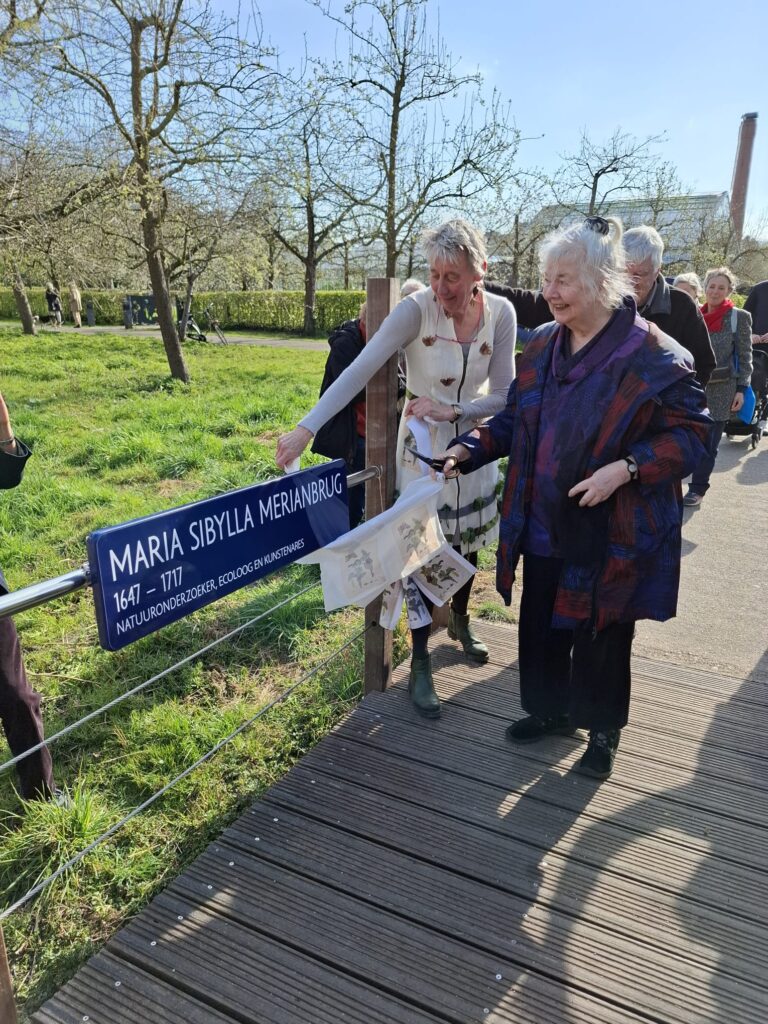
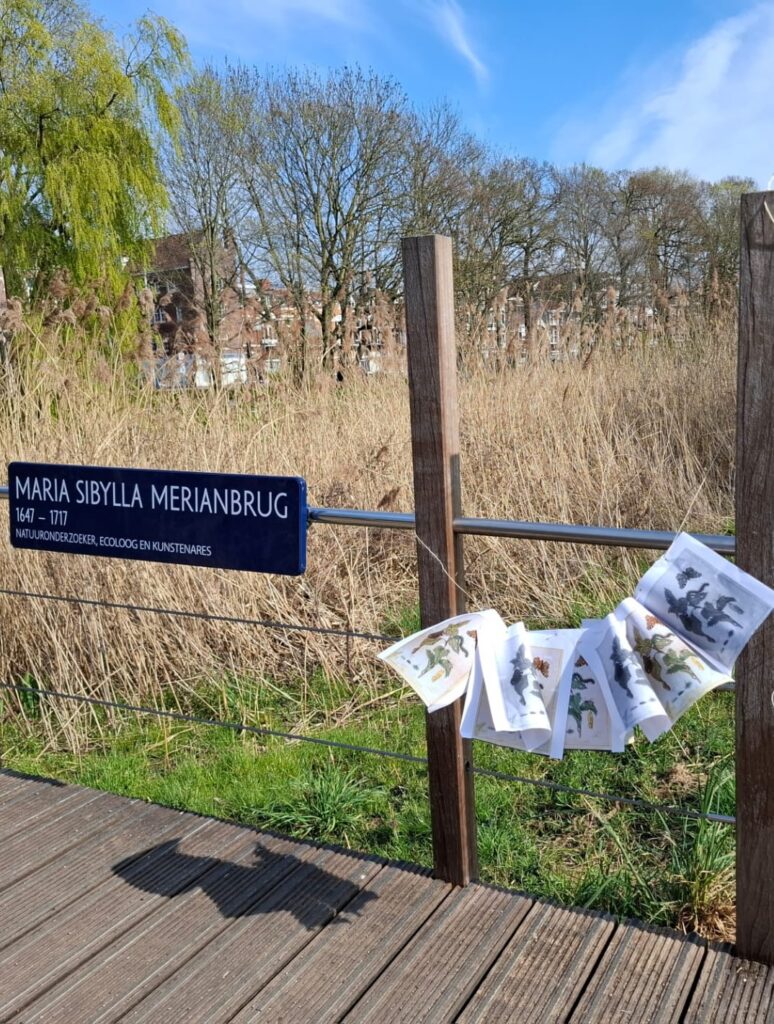
On April 2, 2025, the 378th birthday of Maria Sibylla Merian, the Maria Sibylla Merian Bridge was festively unveiled in Amsterdam. The bridge connects the busy Middenweg with Park Frankendael, a leafy and rural area surrounding a seventeenth-century country estate.
The bridge was built in 2000 based on a design by the architectural firm Sant en Co of Edwin Santhagens and is only accessible to pedestrians and cyclists. Biologist Etje Hulzebos submitted a request to the municipality for naming the bridge, and this was honored by the mayor of Amsterdam. The Maria Sibylla Merian Society owes her a great debt of gratitude for this laudable initiative.
The newly installed nameplate was unveiled on the bridge on the sunny afternoon of April 2 by Merian specialist and initiator of our society Florence Pieters. This took place in the presence of many members and interested guests, listening to speeches and enjoying drinks.
The city of Amsterdam could not have found a more suitable location to pay tribute to Maria Sibylla Merian considering the connection between urban activity and the nature-abundant surroundings that invite to contemplation.
-
Pim Zwier offers a unique experience in film about the life of Maria Sibylla Merian
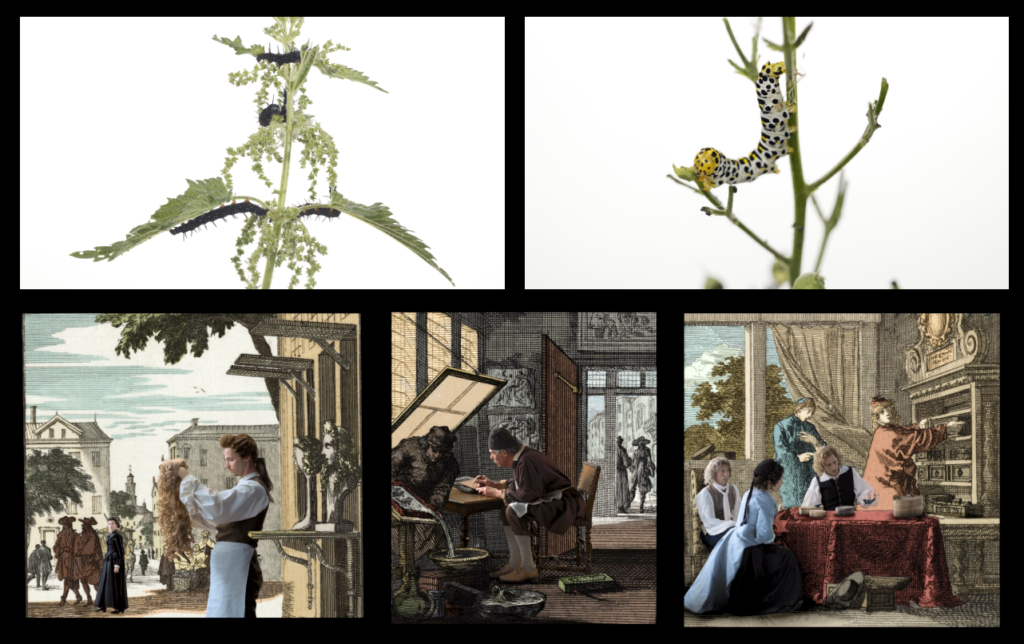
The film Metamorphosis by filmmaker, photographer, and media artist Pim Zwier can be seen in Dutch cinemas from March 2025. The biopic offers a ‘unique film experience’, as a Dutch newspaper described it. As the film tells Merian’s life by quoting textual sources, the film creates a historically sound and accurate image. Moreover, it also offers a stunning spectacle on a visual and artistic level. Scenes about Maria’s life are alternated with breathtaking close-ups of eating and pupating caterpillars. The camera pays ample attention to their activities, creating a hypnotic effect. The scenes informing about Merian’s life are also designed in a peculiar and innovative way: living actors perform their actions against a background of prints and illustrations from Merian’s time. This creates poetic and truthful tableaux vivants with enough room for nuance. Merian’s life naturally offers ample opportunity for over-romanticisation, but fortunately Pim Zwier does not fall into that trap. The Maria Sibylla Merian Society is very pleased with such an intelligent and beautifully designed tribute and hopes that the film will soon be shown in other countries. https://pimzwier.com/metamorphosis-film/
Here are some more quotes from Dutch newspapers:
“The film is a ‘mixture of ‘nature documentary, costume drama and art project’: the film is unparalleled.”
“Yet the real main characters of the film are the caterpillars. Zwier gives them plenty of space: the beautiful, fat, quietly gnawing caterpillars are repeatedly prominently featured, with the plant they live on.” Gemma Venhuizen, NRC, March 18, 2025“Sometimes it’s a costume drama, with actors who seem to have stepped out of a painting and recite old Dutch texts. Sometimes it’s a nature film, with minutes of footage of eating caterpillars, molting caterpillars, pupating caterpillars and just-awakened, slimy and still half-folded butterflies”
“Metamorphosis is made with so much love and precision – from the costumes to the improvised music by baroque orchestra Holland Baroque – that Zwier fully manages to convey his fascination. Even for an unsightly caterpillar that poops, eats and molts.” Pauline Kleijer, De Volkskrant, March 19, 2025 -
Three-hour podcast about the life of Maria Sibylla Merian (in German)
For the broadcaster Deutschlandfunk Kultur, documentary filmmaker and author Halina Dyrschka produced a three-hour podcast about the life and work of Maria Sibylla Merian, in collaboration with Margot Lolhöffel and Kurt Wettengel, among others. Follow this link: podcast Maria Sibylla Merian. Künstlerin, Forscherin, Weltreisende. Dyrschka is also preparing a feature film about the life of Merian: DIE MERIANIN. Click here for a sneak peek and teaser (in English).

-
Kay Etheridge’s The Flowering of Ecology now free online
Publisher Brill has made Kay Etheridge’s book available for free download, making it accessible to everyone. Follow this link: The Flowering of Ecology.
The Flowering of Ecology presents an English translation of Maria Sibylla Merian’s 1679 ‘caterpillar’ book, Der Raupen wunderbare Verwandelung und sonderbare Blumen–Nahrung. Her processes in making the book and an analysis of its scientific content are presented in a historical context. Merian raised insects for five decades, recording the food plants, behavior and ecology of roughly 300 species. Her most influential invention was an ‘ecological’ composition in which the metamorphic cycles of insects (usually moths and butterflies) were arrayed around plants that served as food for the caterpillars. Kay Etheridge analyzes the 1679 caterpillar book from the viewpoint of a biologist, arguing that Merian’s study of insect interactions with plants, the first of its kind, was a formative contribution to natural history.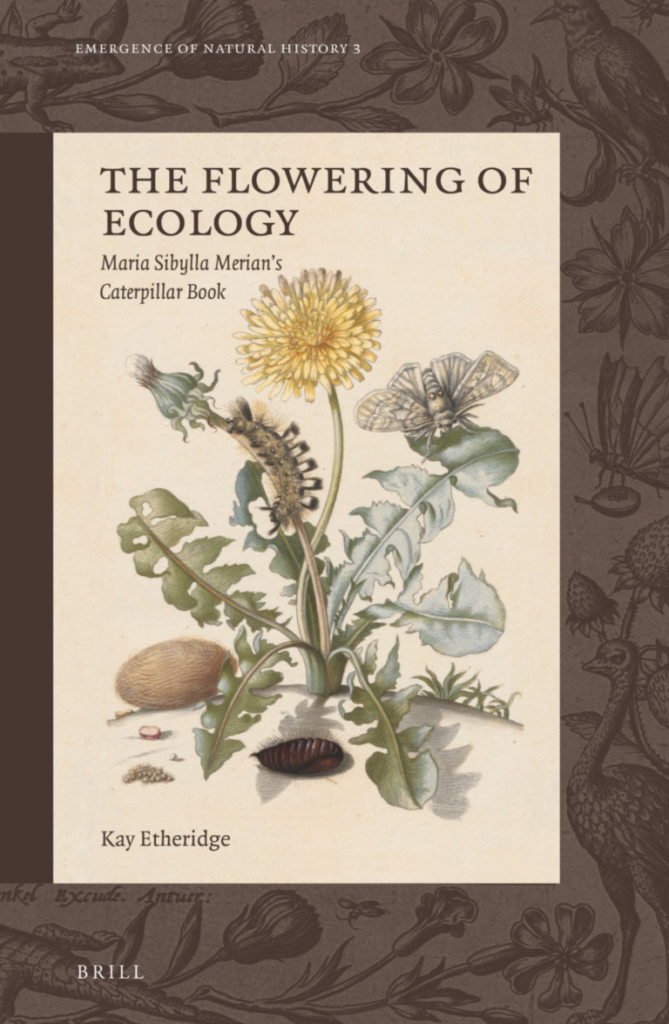
-
Book: Maria Sibylla Merian. Changing the Nature of Art and Science
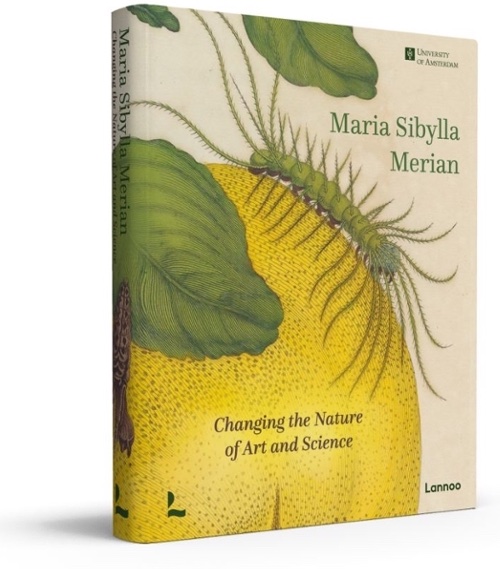
In 2017 an international conference in Amsterdam celebrated the conjunction of new scholarship and artistic works related to this pioneering naturalist and artist. This book is the result of this cross-pollination.
Maria Sibylla Merian (1647-1717), a German-born woman later living in the Netherlands, is famous for her groundbreaking work on caterpillars, moths and butterflies. Her extraordinary story and her contributions to art and science have fascinated many scholars and nature and art lovers, and have inspired artists and writers alike.
This collection of essays provides new insights into Merian’s life and work, re-examines the existing canon, and explores her influence on the contemporary arts. The contributing authors variously investigate her network, her processes and products, and her impact on art and natural history. Her work is compared to that of artists and scientists who preceded and followed her, as well as to that of contemporaries, both male and female. Altogether, this richly illustrated volume presents the most recent knowledge about one of the most remarkable women of the early modern period. The book is edited by Bert van de Roemer, Florence Pieters, Hans Mulder, Kay Etheridge and Marieke van Delft, all members of the Maria Sibylla Merian Society
-
Talk with Marieke van Delft about Merian
In December 2022 Marieke van Delft – former curator of Early Printed editions at KB, national library of the Netherlands and one of the authors and editors of Changing the Nature of Art and Science – was interviewed for a podcast of the University Leiden (Radio Horzelnest) about the life and work of Maria Sibylla Merian. She also discusses the new insights that are presented in this recent publication on Merian. You can listen to the interview HERE (in Dutch).
-
merian.de: New informative website on Merian’s Nuremberg Period 1668-1882
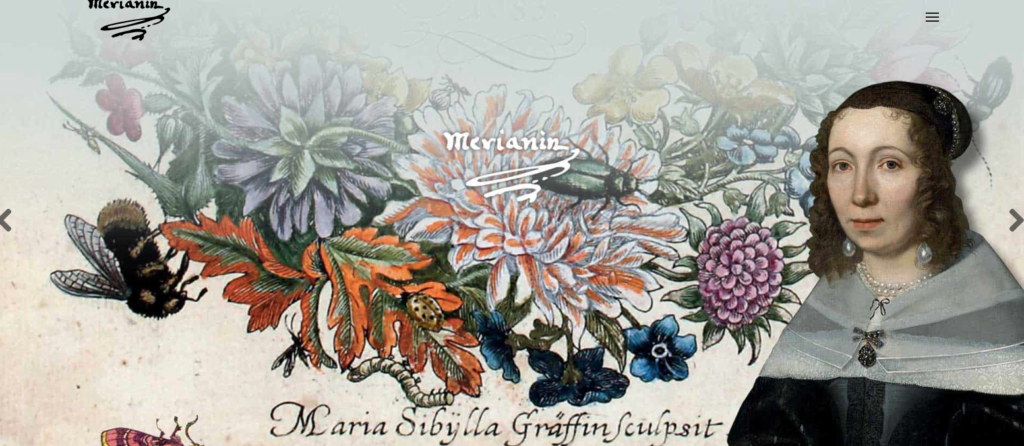
https://merianin.de
The beautifully illustrated website on Merian developed by Margot and Dieter Lölhöffel is a rich resource based on years of work in their home city of Nuremberg. In this city she started her carreer with the help of her husband and many people in her cultural network. In German and English, the site presents detailed information on Merian’s life, including high resolution images from archives not previously published. The page on ‘Nuremberg Works’ includes links to digital copies of several of her early works- just one example of the sources provided in this valuable addition to Merian studies. Furthermore, it connects the work of the ‘first ecologist’ with current projects in Nuremberg protecting insects and biodiversity.