“[…] I consider it necessary to express much in few words: in general, all caterpillars, as long as the insects have mated beforehand, emerge from their eggs […]” (from the preface of Der Raupen wunderbare Verwandelung und sonderbare Blumen–nahrung, Maria Sibylla Merian, 1679).1
Published in a period when insects were thought to generate spontaneously, this bold statement from the 32-year-old Merian was reinforced by her carefully engraved image of a silkworm moth laying eggs. Raised in a family of well-known publishers, Maria Sibylla Merian (German, 1647-1717) was trained from an early age in painting, etching and engraving. However, her life’s work and passion would be the study of moths and butterflies; she raised insects for almost five decades, recording the food plants, behaviour and ecology of roughly 300 species.2 Her most imitated and influential invention was an “ecological” composition in which the life cycle of an insect was arrayed around a plant that served as food for the caterpillar (Fig. 1); prior to Merian’s Raupen (caterpillar) books animal and plant images were segregated, usually in separate volumes.3
Published in a period when insects were thought to generate spontaneously, this bold statement from the 32-year-old Merian was reinforced by her carefully engraved image of a silkworm moth laying eggs. Raised in a family of well-known publishers, Maria Sibylla Merian (German, 1647-1717) was trained from an early age in painting, etching and engraving. However, her life’s work and passion would be the study of moths and butterflies; she raised insects for almost five decades, recording the food plants, behaviour and ecology of roughly 300 species.[2] Her most imitated and influential invention was an “ecological” composition in which the life cycle of an insect was arrayed around a plant that served as food for the caterpillar (Fig. 1); prior to Merian’s Raupen (caterpillar) books animal and plant images were segregated, usually in separate volumes.[3]
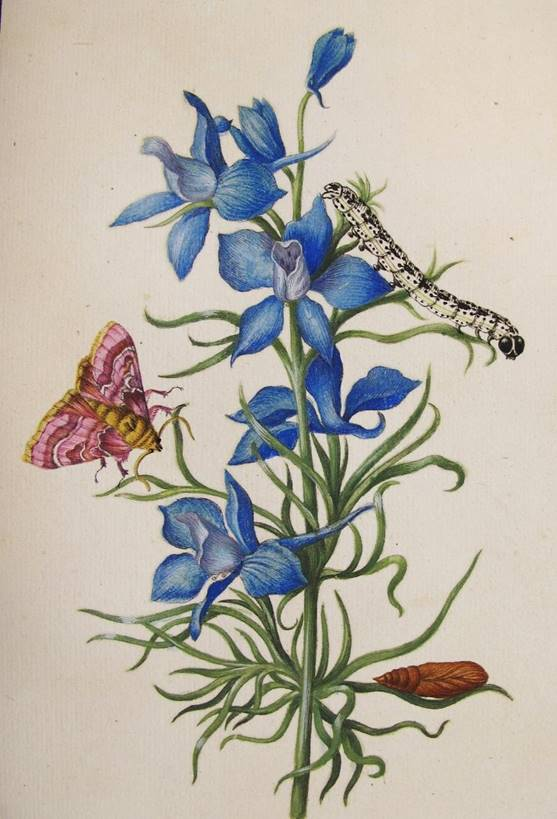
Fig. 1. Plate 40 in Merian’s first Raupenbook (1679).
In 1699 Merian traveled to Surinam to study tropical insects, and is today best known for her magnificently illustrated Metamorphosis Insectorum Surinamensium (1705). Perhaps because of the attention drawn to the larger and more dramatic book on New World plants and insects, her three books on the less showy European organisms have been largely overlooked by contemporary scholars. This is unfortunate because her Raupen books contain observations on interactions among the species she studied over a period of decades, whereas her work on Metamorphosis was completed over a relatively short period. Furthermore, the Surinam volume portrays organisms from a much more diverse and complex tropical environment, which would have been more difficult to study even given more time. Her first two volumes on European insects,published in German, are more detailed in their descriptions than the much later third volume, and here I will discuss only the first Raupen book, published in 1679. This essay will focus on her study of factors central to ecological science, primarily her descriptions of environmental effects on insect development and abundance, and her observations on insect food choice and feeding behaviour.
Merian’s images show not only details of the insects’ life cycles such as the appearance of the eggs and pupae, but specific patterns of herbivory on plants. Almost two centuries after her death, the study of insect-plant interactions became a cornerstone in the growing fields of ecology and evolution, and thousands of papers and books have been dedicated to this critical relationship. Merian was particularly concerned with the food plants of the caterpillars, as this knowledge was essential to achieving the complete metamorphosis of the insects in captivity, but also as it was helpful to gardeners and horticulturists. However, from the specifics she also drew general conclusions that are today central to ecological studies.4 For example, the entry below demonstrates that Merian documented what is now regarded as the important distinction between what ecologists term “specialist” vs. “generalist” feeders: “It is surprising to note that I often kept caterpillars which fed on a single flowering plant, would feed on that one alone, and soon died if I did not provide it for them. On the other hand, I kept many other caterpillars that used more than one plant for their nourishment, though for a number of these one food was preferable. Indeed, they would move immediately from one food to another that they preferred as soon as they tasted it. Then again, I have had six or more species of caterpillars with a definite taste for an assortment of things — in fact, the same things — and which fed on them with equal pleasure, such that I was more than a little surprised by it.” (Ch. 46, p. 93.) Merian frequently recounted the voracious nature of caterpillars, including (correctly) some that will cannibalize each other: “It is curious that this type of caterpillar, when they have no food, will devour each other out of sheer hunger, but will cease doing so as soon as they have food again.” (Ch. 23, p. 48.)
She understood very well that without sufficient and proper food the caterpillars would not successfully metamorphose, and she wrote in Ch. 45 (p. 92): “Finally, it is noteworthy that such ones, like all the other summer-birds [butterflies], not only alight on their food exclusively and mostly fly around such areas […], but usually lay their yellow eggs there as well. Thus, when their little caterpillars emerge from them, they might be supplied [with food] and grow to greater size.” She noted that adult moths often emerged and immediately mated without feeding (we now know that many moths do not form complete mouthparts), but she did document the feeding of some butterflies such as the swallowtail. The adult’s proboscis, shown clearly in Fig. 2, was described as: […] a long beak which it rolls up completely, and if sugar is put out for it, it will place the extended beak on the sugar as if to eat with it. It also uses it to draw the sweetness from flowers, as I have seen it do many times.” (Ch. 38, p. 78).
Both text and images are essential to appreciating Merian’s meticulous observations. In Chapter 38 (p. 77) she commented on a characteristic behaviour in swallowtail caterpillars, which if “touched hard, they immediately extend two yellow horns on the front of their head, like a snail.” Shown everted in the detail from Plate 38 (Fig. 2), these “horns” are now known to be a defensive structure that secretes an odorous compound, deterring predators such as ants. Merian addressed many other means of defense, for example the caterpillar of the moth shown below right in Figure 3:
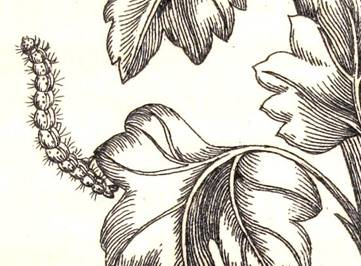
Fig. 3. Detail from Plate 25 in Merian’s first Raupen book.
“If one touches the first kind, like the caterpillar standing upright on one green leaf, it holds fast with its hind legs and thrashes about violently with the front part of its body as if it were angry; in fact, it fastens itself so tightly that one can hardly pluck it off without injuring it.” (Ch. 25, p. 51.) Some behaviours she attributed in part to effects of weather, such as that of the pearl moth caterpillars (Ch. 7, p. 15): “When they are touched, they retreat at once, or lower themselves to the ground by a thread from their mouth, then climb deftly back up the same thread to their house, which consists of small rolled-up leaves, one of which is shown below [at the bottom of the stem]. Thus they are concealed from view and are protected and safe from the heat of the sun and the wet of the rain. When they wish to eat, they run out, and as soon as they have eaten their fill, they hurry back in; there is a constant, lively running back and forth.”
Merian did not attempt to explain everything that she observed, and in general avoided speculation, which sets her apart in another way from many other naturalists of the period. For example, she was the first to portray the seemingly inexplicable metamorphosis of very differently patterned lappet moth caterpillars (Gastropacha quercifolia) into identical pupae and adults (Ch. 17, pp 35-36), something now understood to be caused by variations in the diet of the larvae of some species. But at the end of her chapter on these “Vermes miraculosi” she wrote: “Now whence such dissimilar caterpillars come, even though [they produce] the same kind of insect, the naturalists[die Naturkundigen] can perhaps explain better.” In a more pronounced example of her aversion to speculation Merian leaves it to other naturalists to explain another mystery. She was puzzled for years by what she thought of as “false transformations,” the emergence of parasitic insects from the larvae or pupae of moths and butterflies they use as their host (Fig. 4). In her 1679 and 1683 Raupen book as well as in Metamorphosis she documented such parasites/parasitoids a number of times. By her third caterpillar book (published 1717) she correctly explained the phenomenon.5
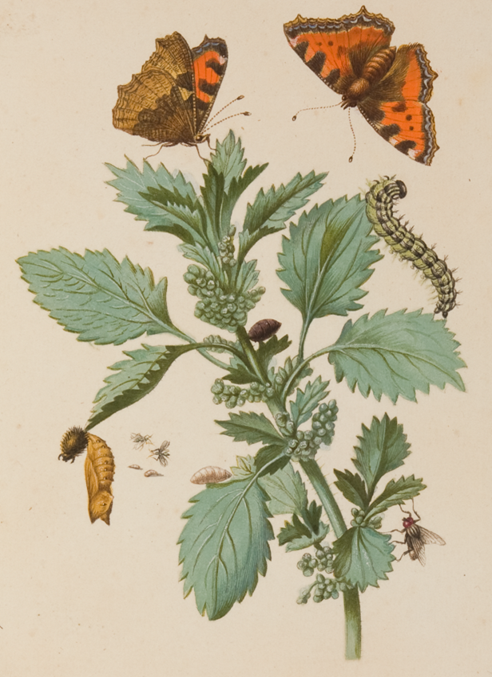
Fig. 4. Plate 44 in Merian’s first Raupen book. (Click to enlarge)
Merian was the first naturalist to draw detailed attention to animal/plant interactions with both word and image, and her work influenced many naturalists who followed her. Much of the information she first published more than three centuries ago withstands the scrutiny of modern biology, and the number of original observations in her work seems astounding in an era when most biologists focus on one or two organisms in their career.
- Translations in this essay are by Michael Ritterson. Merian’s original terms can cause confusion for the modern reader and so for clarity some liberties must be taken with her language. For example, Merian used samen (seed) for eggs and Vögelein (little birds) for butterflies. ↩︎
- Used here for the sake of simplicity, the terms ecology, biology, and science came into use long after Merian. ↩︎
- For more on the influence of Merian’s work see Etheridge, K. and F.F.J.M. Pieters. Maria Sibylla Merian (1647-1717): pioneering naturalist, artist, and inspiration for Catesby. In: The curious Mr. Catesby: A ‘truly ingenious’ naturalist explores new worlds. E.C. Nelson and D. Elliot, eds. Athens, GA: University of Georgia Press. Pp. 39-56, 2015. ↩︎
- Etheridge, K. ‘Maria Sibylla Merian: The first ecologist?’ In: Women and Science: Pioneers, Activists and Protagonists, V. Molinari and D. Andreolle, eds. Newcastle upon Tyne: Cambridge Scholars Publishing, pp 31-49, 2011. ↩︎
- For more on these specialized parasites and Merian’s role in understanding them see Vidal, Stefan. “The History of Hymenopteran Parasitoid Research in Germany.” Biological Control 32: 25–33, 2005. ↩︎