o reveal the distinctive features of Merian’s paintings and etchings, some entomological motifs were analyzed from my point of view as a biologist. To demonstrate characteristic features of her work, it was decided to compare her entomological motifs with those used by several artists from the 17th and 18th century, i.e. Wenceslaus Hollar, Johannes Goedaert, Herman Henstenburgh, Anton Henstenburgh and Johannes Bronckhorst.
The Bohemian etcher Wenceslaus Hollar left Prague at the age of 20. He worked in Germany, England, and the Low Countries. In his diverse opus, he also dedicated himself to drawings of tiny things from the natural world. In London he became acquainted with the natural curiosity cabinet of Lord Arundel, who employed him as an etcher for the catalogue of his insect collection. W. Hollar’s collection of plates, Muscarum Scarabeorum, Vermiumque Varie Figure & Formae (1646), was made in quarto and comprises 11 plates plus a title page. It presents 61 figures of insects. Hidden behind the terms Muscarum [flies], Scarabaeorum [beetles] and Vermiumque [worms], the etchings show butterflies, grasshoppers, single beetle species, dragonflies, wasps, and bumblebees. Another entomological opus by Hollar deals with winged insects, Diversae Insectorum Aligerorum, Vermiumque; etc. […], and it shows pinned specimens. In many cases the morphological details of butterflies, e.g. mouthparts (palpae), antennae, and eyes, are illustrated in detail.
The artist Johannes Goedaert from Middelburg published and illustrated a regional insect fauna, Metamorphosis Naturalis, between 1660 and 1669, consisting of three volumes. His plates show a sequence of caterpillar, pupa, and butterfly, but rarely eggs. Some of his insect motifs can be found almost unmodified in his still-life oil paintings, for instance the Red Admiral (Vanessa atalanta) in ‘Bouquet in a Chinese vase with insects and a snail by Joh: Goedaert’. [http://www.zeno.org/Kunstwerke/B/Goedaert,+Johannes%3A+Blumenvase?hl=gri048].
This species belongs to the family Nymphalidae, the “four-footed” butterflies. Their forelegs are extremely reduced in size, and are not used in locomotion but are modified into cleaning tools instead. The Red Admiral is again depicted in Goedaert’s copper plate (Metamorphosis, part 2 [1667], plate 39), and in this figure it is shown with the correct number of visible legs.
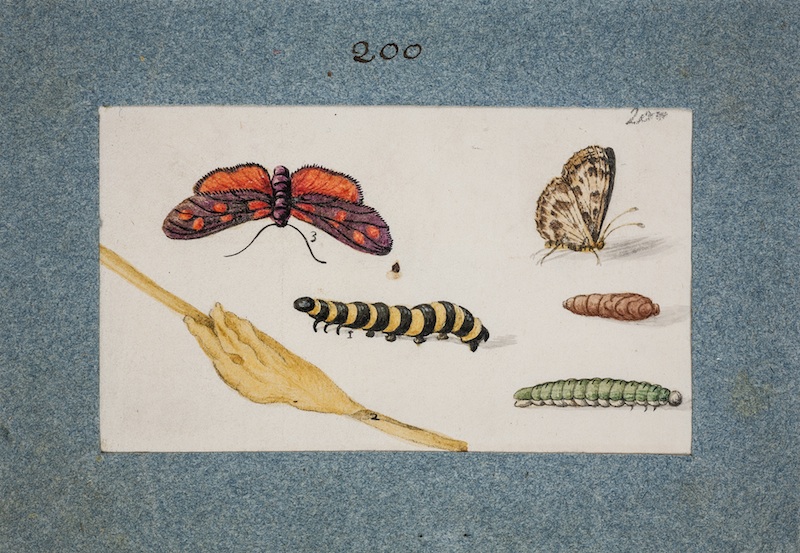
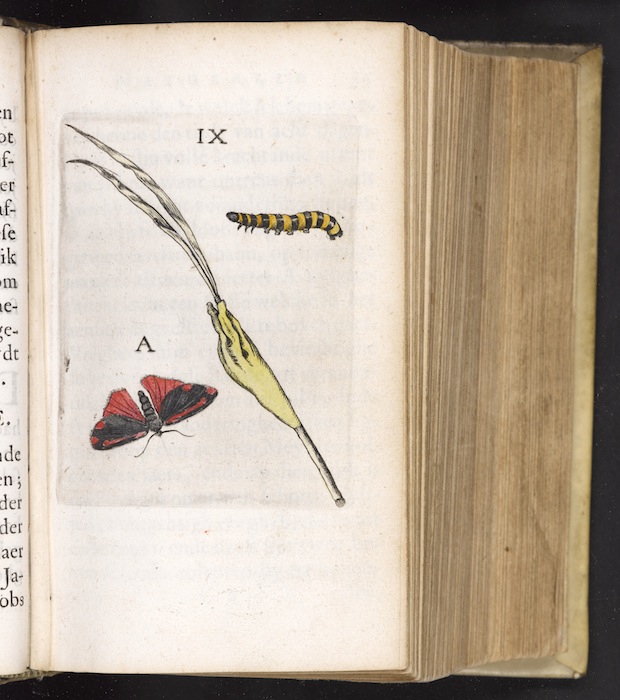
Merian was familiar with Goedaert’s Metamorphosis and used Goedaert‘s books as an important source of information. This is evident from notes in her Studienbuch; as a metaphor of resurrection, Goedaert’s [incomplete] life cycle of the Goat Moth (Cossus cossus), Metamorphosis (part 2, plate 33), was highly valued by Merian.1 – One illustration (Fig. 1) in her Studienbuch depicts part of the life cycle of a Burnet moth. Here she adopted or copied motifs from Goedaert’s moth illustration, plate IX (Fig. 2). However, Goedaert depicted a different species, the Cinnabar Moth (Thyria jacobaeae). Thereby he included the incorrect pupal stage, a papery cocoon, characteristic of a Zygaena moth. Merian, already familiar with the cocoon and imago of the Zygaena moth but not with the larval stage, relied on Goedart’s image with regard to the caterpillar. Therefore, in her Studienbuch, Merian copied and added the wrong caterpillar to the otherwise correct association of cocoon and imago.2 Both the Burnet moth and the Cinnabar moth are diurnal species, and their black and red wing pattern is confusingly similar.
Regarding the different morphological characteristics such as the antennae, legs, and proboscis, the aforementioned artists exhibited different degrees of accuracy. An example would be the spatial presentation of the habitual appearance; very often, Merian chooses to depict the dorsal, ventral, and lateral view. Butterflies that keep their wings folded back are seen either with closed or slightly opened wings allowing the observer to get a glimpse of the upper side of the forewing. Commonly, Merian’s illustrations of insect antennae show distinct deviations in the length and orientation of the right and left antenna, whereby one is usually more curved than the other. The insect proboscis consists of two half-tubes which, in some of Merian’s works, have been modified into paired spirals for decorative purposes. Indeed, in juvenile moths of this type, the two half-tubes are still separate to be subsequently “zipped up” in the mature adult insect. In particular, the sphingid moths with their long proboscis are shown with distinctly looped tongues. This feature is quite often seen in depictions from her Metamorphosis Insectorum Surinamensium (1705).
Maria Sibylla Merian was famous for carefully looking at details. She documented a variety of organic structures: caterpillar exuviae, empty puparia, a single head capsule of a mounted caterpillar, or rod-shaped feces (characteristic of Hawk Moths). Merian’s talent to observe and draw tiny things was extraordinary. Her texts and images provide a lot of information on parasites of moths and butterflies at all their developmental stages (Fig. 3).
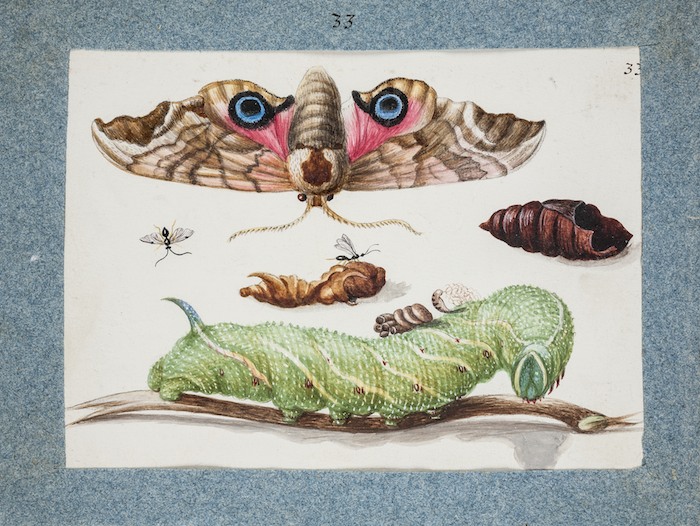
Throughout their whole life cycle, she documented butterflies and moths being parasitized by wasps and flies. Not yet aware of the host-parasitoid relationship, she called these phenomena ‘false’ transformations. From a biologist’s point of view, Merian’s work is an important source of information on parasitology by introducing ecological information. For example, her depictions may show caterpillars with larvae of parasitic Apanteles wasps or pupae of parasitic tachinid flies on the outer surface of their dead host. Goedaert showed in his Metamorphosis an illustration depicting the emergence of parasitic wasps (Chalcididae) from a pupa of the Large Tortoiseshell (Nymphalis polychloros) (part 1, plate LXXVII) as well as larvae of parasitoids on the skin of a caterpillar (part 1, plate LXII), but these are exceptions to his work.
Merian reused her insect motifs several times. For example, she copied Goedaert’s caterpillar and pupa of the Magpie Moth (Abraxas grossulariata) from Metamorphosis (part 1, plate XXXI) for her Studienbuch, fig. 45, and appended a moth imago as well as a cluster of eggs (Beer 1976: pl. 18, fig. 45). She used these four motifs again in Der Rupsen Begin, voedzel en Wonderbaare Verandering […] [1717], (part 3, plate 29). The Magpie Moth depicted in her illustration is erroneously furnished with club-shaped antennae. This wrong detail was propagated through her work and reappeared in the aforementioned copper plate as well as in a watercolour and gouache on parchment with insects and plants (Sloane collection in the British Museum [BM, SL 5276 111]).
Almost always when Merian intended to show butterflies in flight, she presented them from an upper view as if she had drawn them from pinned specimens. In contrast, the painters Herman Henstenburgh and Johannes Bronckhorst from Hoorn, who also painted insects in flight, did succeed in presenting them in a more realistic manner. The perspective they adopted is defined as the three-quarter profile and comes very close to how butterflies really appear in flight. Actually, Bronckhorst was a teacher of Henstenburgh.
Comparing a pinned specimen of a Malachite butterfly (Siproeta stelenes) from a museum collection [http://commons.wikimedia.org/wiki/File:Siproeta_stelenes_meridionalis_MHNT_ventre.jpg] with Herman Henstenburgh’s depiction [https://rkd.nl/explore/images/119674 ], it is impressive to see how meticulously colour, shape and morphological structures (venation) are presented. Although Henstenburgh’s butterfly is shown from the underside and probably intended as an artistic drawing, it is very close to a scientific illustration and could easily be used for a field guide.
As we certainly can see from paintings of Anton Henstenburgh, Herman’s son, all three (the older and the younger Henstenburgh, and Bronckhorst) can be assigned to the same school. Again, Anton presented depictions of flying butterflies in the three-quarter profile. The younger Henstenburgh, who started painting at the age of 13, is successfully trying to be as detailed as possible (Braunschweig, Herzog Anton Ulrich Museum, Antoni Henstenburgh, Album H 27).
The following examples serve to demonstrate how I proceed in analysing paintings from a zoological perspective: The British Museum holds a painting of a flowering Marian thistle (Silybum marianum) with two insects (wasps) visiting the plant (ca. 1691-99, Sloane album, SL 5276.42)[http://www.britishmuseum.org/system_pages/beta_collection_introduction/beta_collection_object_details.aspx?objectId=709119&partId=1&searchText=SL%2c5276.42&images=true&people=115005&page=1]. It is not signed but was apparently painted by M.S. Merian or one of her daughters. The other one is a nearly identical copy and differs only in colouration and in some entomological details: beside the wasps, two caterpillars and two cocoons can be recognized. This artwork is in the Royal Collection of Windsor Castle (ca. 1705-1710, Reference: RL 21224 [http://www.royalcollection.org.uk/collection/921224/unused-design-for-the-metamorphosis-insectorum-surinamensium]. The practice of copying is widespread in Merian’s work.
Another very similar watercolour on vellum of a flowering Marian thistle is currently attributed to Maria Sibylla Merian, apparently because it contains lots of details of Merian’s thistle motifs and is even monogrammed ‘M.S.M’ (verso) [http://www.fitzmuseum.cam.ac.uk/dept/aa/opac/cataloguedetail.html?&priref=4827&_function_=xslt&_limit_=25]. However, a closer look reveals the three-quarter profile of a flying butterfly, a Speckled Yellow (Pseudopanthera macularia). As was discussed before, M. S. Merian does not depict flying butterflies and moths in a three-quarter profile. This insect seems more representative of a Henstenburgh or a Bronckhorst type of moth. Furthermore, the bird, a Purple Honeycreeper (Cyanerpes caeruleus), is obviously derived from at least one painting made and signed by Herman Henstenburgh: [https://rkd.nl/explore/images/120290]. Or take a look at the two land snails (Cepaea spec.) that are very likely to be from Henstenburgh’s hand. The land snail motif is commonly used in his still-life drawings. Therefore the question remains: Do we have proof for H. Henstenburgh’s attribution regarding the Cambridge painting? Did someone in the Merian workshop copy Henstenburgh’s thistle, and if so, when and where did that happen? The painter Herman Henstenburgh was active in the northern Netherlands between 1683 and 1726, but there is no evidence for Henstenburgh having ever left his hometown Hoorn. So I suggest that the painting found its way to Amsterdam by trading, where M.S. Merian or her daughters might have seen it, but further research needs to be done.
Therefore, it can be argued that scientific details can help to properly attribute artworks to their original creators. Take for instance one last comparative example. First, consider the painting of a St. Benedict’s thistle (Cnicus benedictus) and two Painted Ladies (Vanessa cardui) [http://www.britishmuseum.org/research/collection_online/collection_object_details/collection_image_gallery.aspx?assetId=326204&objectId=709121&partId=1]. It can undoubtedly be assigned to M. S. Merian, who apparently signed it (‘M. S. Me. fec.’). The butterfly is shown from above and from aside, with its wings slightly opened. Secondly, the watercolour ‘Branch of Pomegranate blossom and a split fruit, with Metamorphosis of the Painted Lady and Parasitic Wasps’ [http://www.lodiedue.com/fiere/1353925917_big.jpg]. It has traditionally been attributed to Maria Sibylla Merian. At first sight, one is indeed inclined to associate the signed painting (“M. S. Merian fec.”) with the artist.
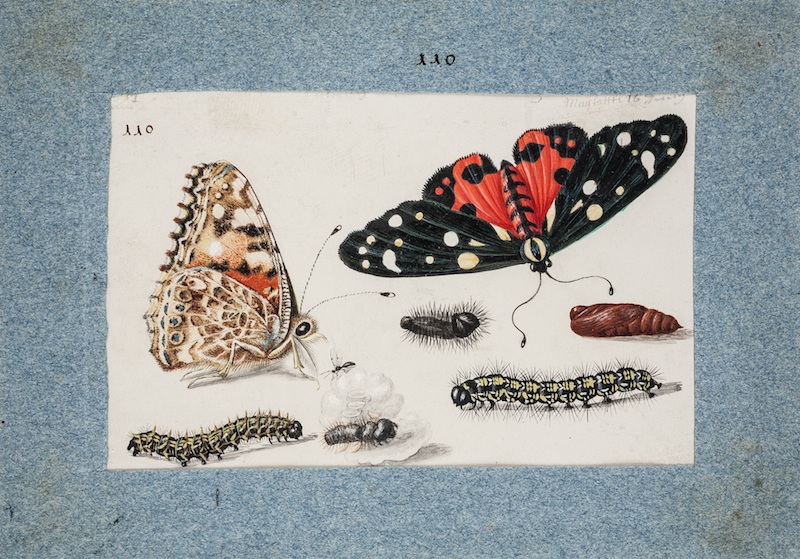
But, again, look at the entomological details. First, the number of legs: in Merian’s original, she depicts two visible legs of the foot-brushed, nymphalid butterfly. In the Pomegranate copy, the same butterfly has three visible legs, the third one is fully developed. It is most unlikely that this error could have occurred to Maria Sibylla Merian. We can easily derive from the artist’s Studienbuch that she was familiar with the actual nymphalid anatomy and therefore correctly figured an anterior leg modified to form a foot-brush (Fig. 4). Second, the perspective is unusual for a work authored by Merian; while the upper butterfly is shown from above and appears very close to the model, the wings of the perching butterfly are depicted opened from the rear side, not from the fore side. So I suggest that the Pomegranate watercolour is from an unknown artist, but it is strongly influenced by Maria Sibylla Merian’s series of artworks depicting the ‘branch of Pomegranate blossom and split fruit’.
Conclusion: Considering biological details of an insect can help to assign attribution of naturalists’ artworks more reliably. For scientific work, high quality pictures and their proper digitization are urgently needed to study those details. This opens further opportunities beyond studying the primary document, which is indispensable whenever the original is accessible.
Suggested reading
Wolf Dietrich Beer (ed.), Maria Sibylla Merian: Schmetterlinge, Käfer und andere Insekten. Leningrader Studienbuch, 2 vols. Leipzig & Luzern 1976.
Vladimír Denkstein, Wenceslaus Hollar: Zeichnungen, Praha 1977.
Anne M. Zaal, Herman Henstenburgh (1667-1726), Hoorn: Stichting Vrienden van het Westfries Museum, Hoorn 1991.