It was in the years between 1699 and 1708 that an Amsterdam trader named Baltasar Scheid (ca. 1660 – ca. 1724) wrote letters and sent plants, seeds etc. to Nürnberg to the physician and botanist Johann Georg Volkamer (1662-1744), informing him next to other interesting news also about the ongoing work of Maria Sibylla Merians’s Metamorphosis Insectorum Surinamensium. Scheid must have been well-known to Merian for she asked him to send in her name prints of copperplates of the Metamorphosis to Volkamer. Later, in 1714, the English botanist Richard Bradley (1688-1732) visited M.S.Merian during his stay in Holland to meet the artist who had contributed at least one painting for his Historia Plantarum Succulentarum. Bradley came into contact with Merian through James Petiver (1663-1718), apothecary in London, with whom Merian corresponded, and Bradley reported to him about his visit.
Baltasar Scheid
From the eighteen existing Merian letters we know that Maria Sibylla Merian had connections to Nürnberg as well as to London.1 The first of the extant Nürnberg letters was written in 1682 to Clara Regina Imhoff, a former pupil; the later ones up from 1702 to 1705 to the physician and botanist Johann Georg Volkamer. No further letters addressed to correspondents in Nürnberg are presently known. In these Nürnberg letters to Volkamer Merian mentioned several times a “Mr. Schey” or “Schrey” who did send on her behalf natural products and newly printed plates of the Metamorphosis to him (Merian letters 7; 8; 13; 14). This ” Mr. Schey ” is the Amsterdam trader Baltasar Scheid, who was also active for the same Volkamer until at least 1708. Up to 2007 Scheid was unknown in literature.2 Little is known about Scheid. According to Zacharias Conrad von Uffenbach (1683-1734), a scholar from Frankfurt am Main, Scheid was born around 1660 – his age is to be found only in the handwritten diary of his Merkwürdige Reisen durch Niedersachsen, Holland und Engelland from 1710/11, not in the printed copy of 1754.3 The Amsterdam apothecary Albertus Seba (1665-1736) wrote in 1724 to Volkamer about a very sick Scheid. Probably he died that year.4
The University Library of Erlangen, Dept. of Manuscripts, is in possession of 44 letters of Baltasar Scheid, written in the years between 1699 and 1708.5 In fourteen of these Merian is mentioned, but twelve are most interesting for us because he wrote about the ongoing work on Metamorphosis Insectorum Surinamensium. In these letters Scheid also informed Volkamer about the progress on the Amboinsche Rariteitkamer by Georgius Everhardus Rumphius (1627-1702), as both books were of great interest to Volkamer.
From these letters we learn that the printing of Metamorphosis started between March and April of 1703 rather than in June of that year. Scheid sent the subscription conditions in March and a first proof in April to Volkamer (Scheid letters 18; 19), whereas Merian only promised a proof in October 1702, but did not send one before June 1703 to the London apothecary James Petiver (Merian letters 8; 9). Moreover, still following Scheid, the printing work was terminated in February 1705, when he ordered the colouring of a copy of Metamorphosis for Volkamer. As he never wrote about an order for colouring before that date, we can assume that the printed volume was ready in February 1705.6
Thus, the production progress between the beginning and end went as follows: from April to September 1703, 15 copperplates were engraved according to Scheid (Scheid letters 19;24). In October 1703, Merian herself wrote that 20 plates would soon be finished (Merian letter 11). In April 1704 she wrote that more than 30 copperplates had been produced (Merian letter 12). Early July Merian was thinking of printing the accompanying text, wrote Scheid (Scheid letter 26). By the end of that month 50 plates had been engraved (Scheid letter 27), and in February 1705 the entire set of 60 copperplates was finished (Scheid letter 29). Thus, according to Baltasar Scheid, the work on the plates of Metamorphosis started and ended earlier than described in the information given by Merian herself.
Just some further remarks on Scheid’s letters: we read that Madame Merian avancirt wacker mit ihrem Werck (is proceeding pretty well with her work), whereas publisher François Halma has always new excuses as to why the work on Rumphius’s Rariteitkamer is taking such a long time (Scheid letter 26). Scheid also complained about the quality of the paper for the Rariteitkamer, while writing that Madame Merian has used a much better paper. We also learn from Scheid that Frl. Merian (i.e. young lady Merian = Dorothea Maria) did the colouring of the Metamorphosis for Volkamer’s brother (Scheid letter 30). This I think is the only written information about the teamwork of mother and daughter Merian.
Richard Bradley
The English addressee of Merian’s letters was James Petiver with whom she corresponded till at least 1712; he was the link between Merian and Richard Bradley. At the time, Bradley was known for his numerous publications on gardening, husbandry and agriculture. Although he did not hold a university degree, he was elected the first Professor of Botany at Cambridge. In 1712 he became Fellow of the Royal Society through the support of Petiver and Sir Hans Sloane (1660-1753), all of whom were very interested in natural history. Bradley had for long specialized in succulents and issued his Historia Plantarum Succulentarum, a work in five decades of ten plates each, in the years between 1716 and 1727.
For his succulent work, Bradley sought the help of Petiver for whom he made drawings or collected natural history specimens. As we know from Merian’s letters, Petiver owned copies of her books and he also had some paintings of hers that he could have bought during his stay in Holland in 1711.7 Bradley may have seen Merian’s work in Petiver’s house. It is fairly certain that Petiver had told Bradley about his visit to Merian’s house and about one of her paintings of the Aster ficoides, for he knew about Bradley’s interest for these plants. This explains Bradley’s request in a letter to Petiver, written between 1711 and 1714: please to Intimate that what Draughts of Ficoides are Done by Mad:m Marian [sic] may not Exceed the Quarto Size.8
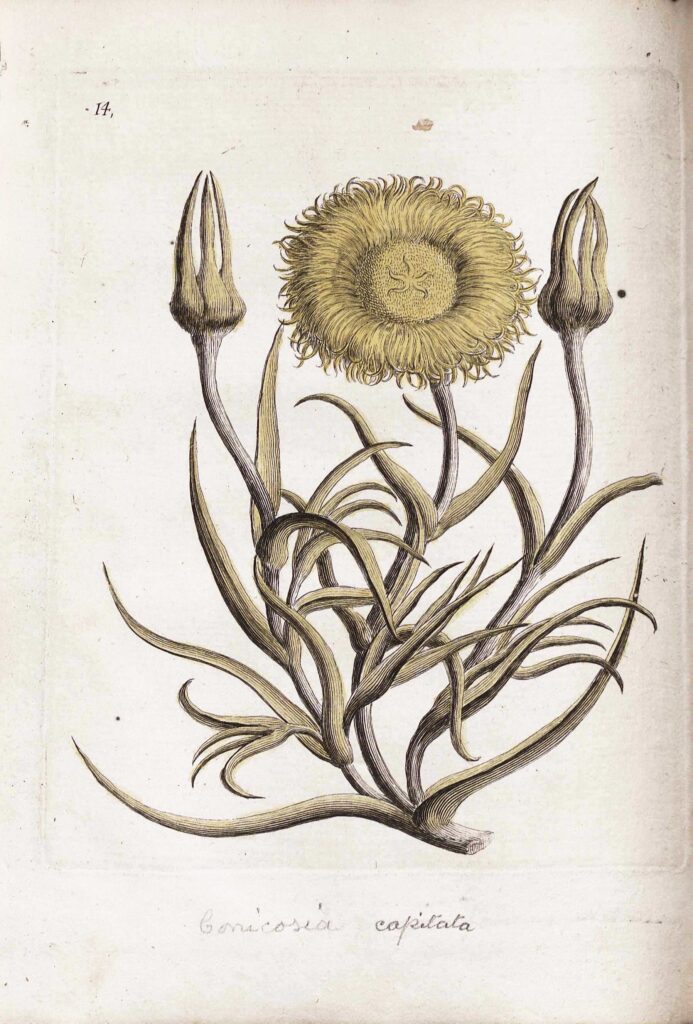
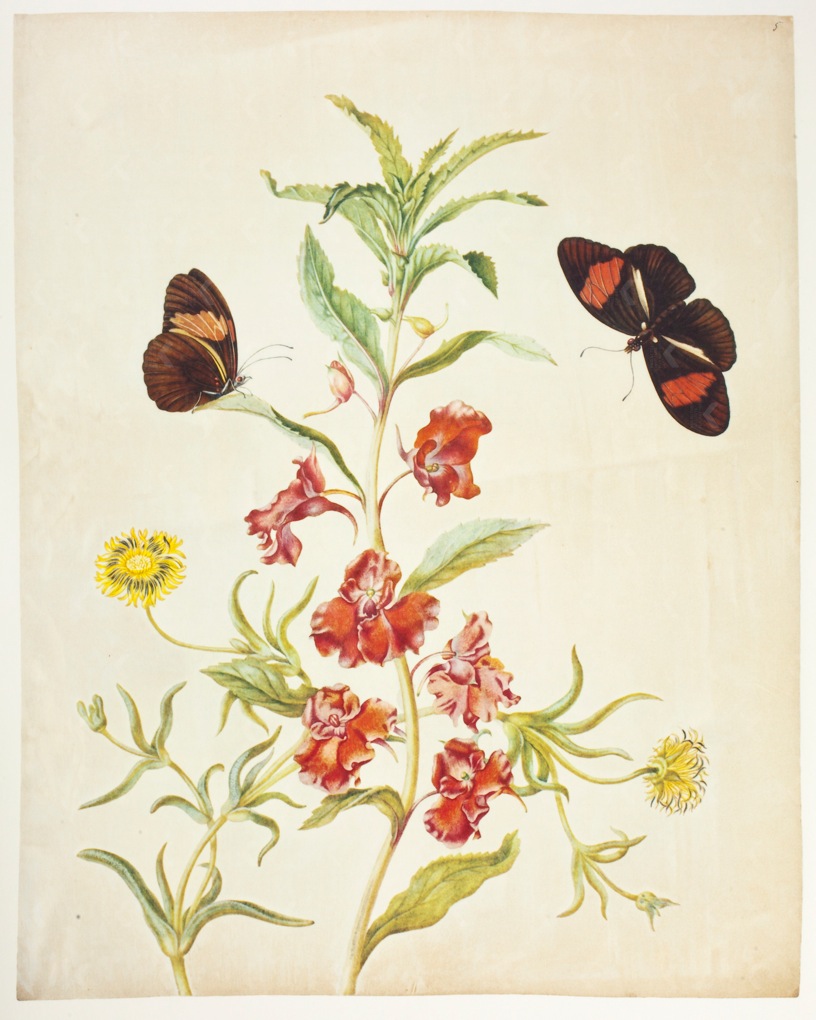
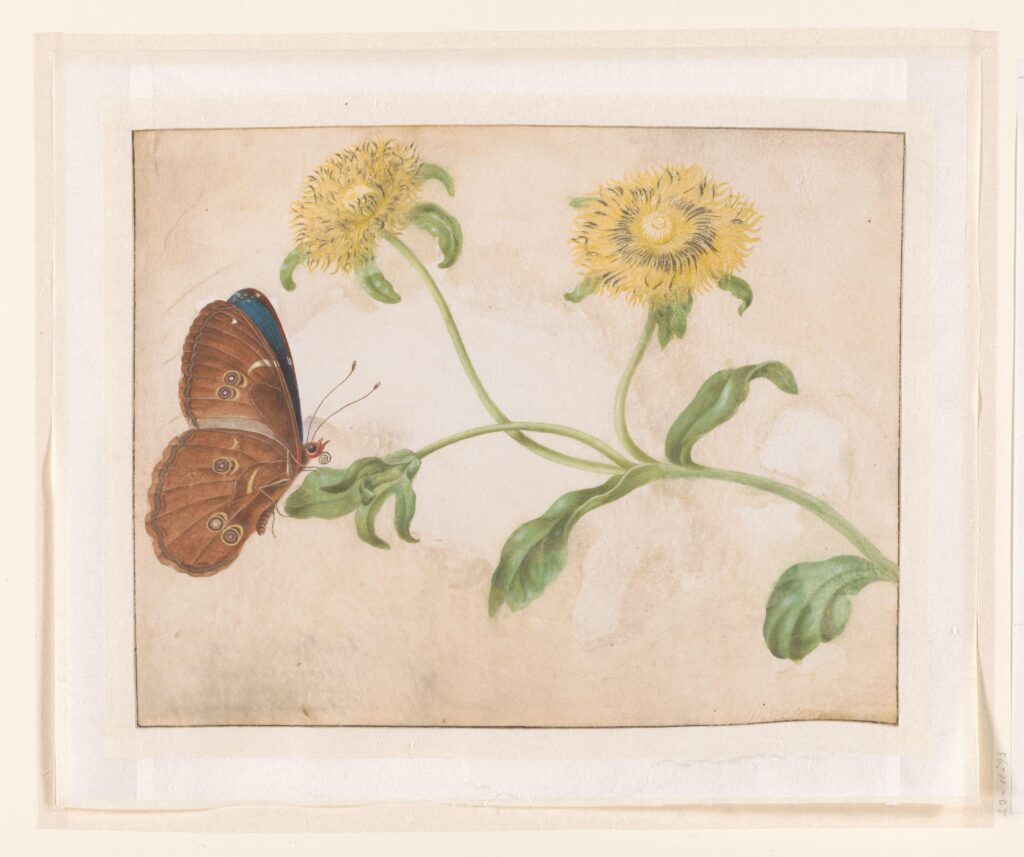
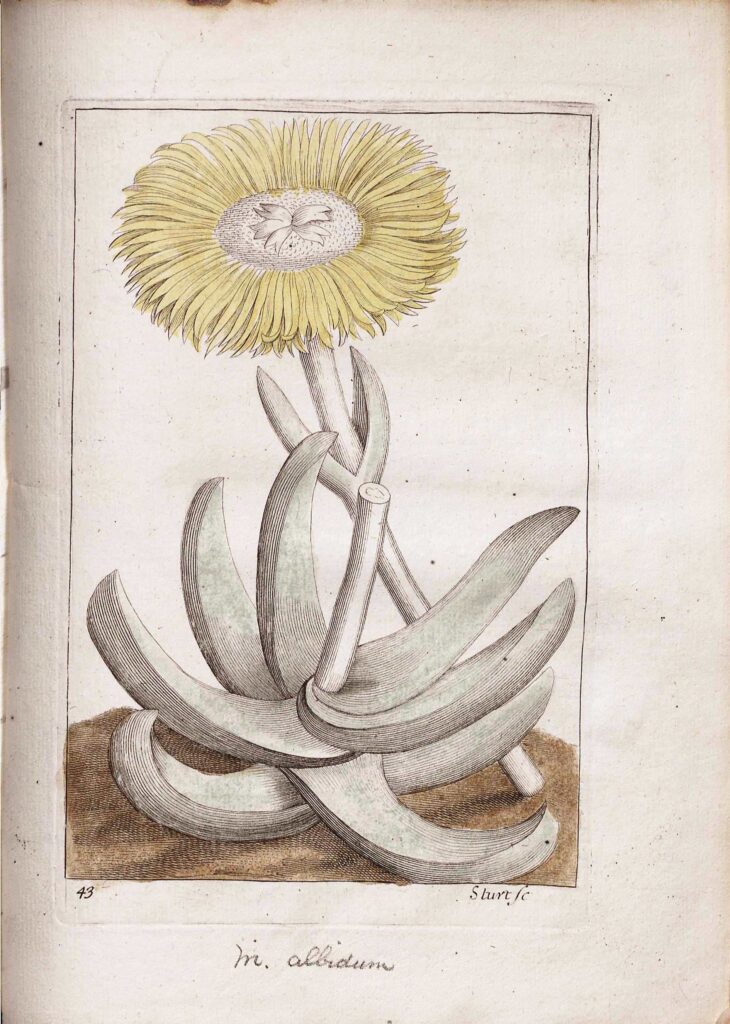
Now it seems possible that Merian did such a painting for Bradley indeed, for she was most interested to become better known in England and to gain new customers there. Plate 14, Decae II (1717) from Bradley’s Historia Plantarum Succulentarum shows Ficoides capensis (Figure 1). Ficoides is an old name for the family Mesembryanthemaceae, and there is a very similar painting by Merian in St. Petersburg of another Ficoides, presently named Lampranthus (Figure 2). Another painting by Merian of a Ficoides is kept in the Rijksprentenkabinet in Amsterdam (Figure 3). The way of drawing the fleshy leaves as well as their base and blossoms is nearly the same. The whole plant represented in Figures 1 and 3 is done in an elegant and harmonious way and very different from Bradley’s Plate 43, Decade V (1727) of the related Ficoides Africana folio triangulari. The latter was very probably drawn by Bradley himself (Figure 4) and this purely scientific drawing is absolutely incomparable with Merian’s artistic drawings.
Petersburg, inv. nr. 10-85-5.
When traveling to Holland in 1714 to collect rare plants and seeds as well as insects and to draw whatever could be of interest to Petiver and the Duchess of Beaufort (1630-1715), Bradley visited Merian. He wrote to Petiver (July 1714) that he was overwhelmed by what he saw in her house.9 Everywhere were original paintings: of the Rariteitkamer, of her Raupen, 32 leaves of fine birds, a large folio of plants from the Amsterdam Garden that may be the same volume as the one mentioned by Von Uffenbach,10 and the two volumes in folio of Commelin’s Horti Medici Amstelodamensis with the prints Colour’d after the Life. And for all this he mentioned prices, namely: 100 Guineas for the Rariteitkamer, that is more than 1000 florins; for the Raupen 500 florins; the 32 birds she wanted to sell for 400 florins; the large folio with the plants from the Amsterdam Garden for 600 florins and Commelin’s work should cost the amount of 200 florins. The last one she probably sold for her daughter Johanna Helena (at that time in Surinam), who contributed some paintings to the Atlas Moninckx which contains originals for the Horti Medici Amstelodamensis, and who might have coloured some of these books as well.11
The price for the Raupen given by Bradley is quite interesting for a comparison with other quotations. But it should be taken into consideration that in July 1714 perhaps all of the paintings for Part III had been done; this means a cost of 500 florins for 150 paintings on parchment, or nearly 170 florins per book containing 50 plates each. The same book with 50 plates gemahlt (painted), meaning coloured counterproof or replica on paper for 20 florins (Merina letter 17), a book with 50 plates coloured for 10 florins (Merian letters 11; 17), and an uncoloured copy for only 2 ½ florins (Uffenbach,Teil 3: 552-554). Obviously, there is an enormous difference between a painted work on parchment and a simple black and white print.
Transcriptions and translations of Merian letters
Merian’s letters have been transcribed by Stuldreher-Nienhuis and Rücker.12 Both refer to the same original handwriting, but differ very often in transcription. Is it Tugentreiche(St.-N.) or tugent Reiche (R.), Frauenzimmer (St.-N.) or frauwenZimer (R.), Vatter (father) (St.-N.) or Vetter (cousin) (R.) (Merian letter 1 (St.-N.), i.e. letter 2 (R.))? Another example: sometimes Stuldreher-Nienhuis writes more words in a sentence than Rücker does. However, the old way of writing a word cannot be changed into the modern way, or words within a sentence should not be changed. Likewise, the translation of the letters from German into English is sometimes problematic, but 2 muschel grundfarb has nothing to do with 2 shells of ground colour, it simply means Primärfarbe = primary colour, i.e. blue, yellow or red (Merian letter 3).
Another example: the translation from the letters written in Dutch or French into German and English is often wrong. If the original is written in present tense, one should not transfer into imperfect tense: Les Biliettes contiennent cannot be translated into the letters contained, it means instead: they contain. Souhaiter remains to wish and should not be changed into hésiter – to hesitate. And il en est prèst plus que la moitie means more than half of it is finished and not almost half is finished. To translate L0 procent into 50 percent is nonsense, Merian actually did not want to pay 10 percent to Levinus Vincent (all these examples from Merian letter 12). In letter 17 the sentence: … so kost … das in quart 20 fl hollendisch, der eines in [ … ] erwagen hoffe gethan zu haben … should be corrected into: … deren eines in 3 wogen hoffe gethan zu haben … In letter 18, written in Dutch, Merian offered 2 duysent been to Petiver. This is translated into two thousand bones, but Merian never sold bones! What she offered were two centipedes or millipedes, Ella Reitsma and Sandrine Ulenberg give the correct translation.13
Obviously, it seems to be necessary to review all transcriptions as well as all translations of Merian’s letters. That would be a good aim to set before the next commemoration in Amsterdam in 2017, on the occasion of the 300th anniversary of her death.
- The numbers of the Merian letters refer to Wettengl, K. (1997: 262-269). ↩︎
- Wirth (2007); Kinukawa (2011). ↩︎
- Uffenbach, Z.C. von, 1710/11. Merkwürdige Reisen durch Niedersachsen, Holland und Engelland, Staats- und Universitätsbibliothek Göttingen, Handschriftenabteilung, Nachlaß Uffenbach, 80 Cod. Ms. Uffenbach 25, Teil 3, p. 703. ↩︎
- Wirth (2007: 123). ↩︎
- Universitätsbibliothek Erlangen, Briefsammlung Trew – Baltasar Scheid – letters numbered 1-44; Wirth (2007: 116). ↩︎
- According to the newspaper Opregte Leydsche Courant, the printing of the edition of Metamorphosis with letterpress in Dutch was ready on 2 March 1705, while the edition with Latin text was still in press. ↩︎
- Van Gelder (1997: 148-149). ↩︎
- Henrey (1975, 2: 429). ↩︎
- Tjaden (1974, 9 (1): 9). ↩︎
- Uffenbach (1754, Teil 3: 552-554). Uffenbach did not say that these plants were drawn from the Amsterdam hortus. ↩︎
- Wirth (2007: 143). ↩︎
- Stuldreher-Nienhuis (1944: 171- 174); Rücker (1982: 61-75). ↩︎
- Reitsma & Ulenberg (2008: 226).
↩︎
- Gelder, R. van, 1997. Zwischen Kunst, Kommerz, Liebhaberei und Wissenschaft. In: Wettengl (Ed.) 1997: 136-149.
- Henrey, B., 1975. British Botanical and Horticultural Literature before 1800. 3 vols, London.
- Kinukawa,T., 2011. Natural history as entrepreneurship: Maria Sibylla Merian’s correspondence with J.G. Volkamer II and James Petiver. Archives of Natural History, 38 (2): 313-327.
- Reitsma, E. & Ulenberg, S., 2008. Maria Sibylla Merian & Daughters. Women of Art and Science. Amsterdam, Los Angeles & Zwolle.
- Rücker, E., 1982. The letters. In: Rücker, E. & Stearn, W.T. (Ed.) Maria Sibylla Merian in Surinam. London: 61-75.
- Stuldreher-Nienhuis, J., 1944. Verborgen paradijzen. Het leven en de werken van Maria Sibylla Merian 1647-1717. Arnhem.
- Tjaden, W., 1973-1976. Richard Bradley, F.R.S. 1688-1732, Succulent Plant Pioneer. The Bulletin of the African Succulent Plant Society (ASPS) 8 (4), pp. 132 et seq. (18 sequences).
- Uffenbach, Z.C. von, 1754. Merkwürdige Reisen durch Niedersachsen, Holland und Engelland, Teil 3. Ulm.
- Wettengl, K. (Ed.), 1997. Maria Sibylla Merian, 1647-1717; Künstlerin und Naturforscherin. Frankfurt am Main.
- Wirth, B., 2007. Maria Sibylla Merian, Baltasar Scheid und Richard Bradley – Die Künstlerin und Naturforscherin, ein Kaufmann und ein Botaniker. In: Annals of the History and Philosophy of Biology, 12: 115-153.