In the seventeenth and early eighteenth century artist and naturalist Maria Sibylla Merian was a remarkably self-reliant woman of diverse talents. The story of her life is by no means typical for her time. Born the daughter of the renowned publisher Matthäus Merian the Elder in Frankfurt am Main in April 1647, she spent the most important phases of her life in Frankfurt am Main, Nuremberg, in a Labadist community in Friesland, and in the cosmopolitan city of Amsterdam. In 1699 she embarked in the company of her daughter Dorothea on a dangerous voyage to the Dutch colony of Surinam to study the world of exotic butterflies. Maria Sibylla Merian received her training in the art at the hands of her stepfather Jacob Marrel, a student of Georg Flegel, the first of the German still-life painters.
Maria Sibylla Merian began observing insects at the age of thirteen. It was not long before she undertook her first systematic studies of butterflies, which, although still largely unknown to science in the mid-17th century, were the subject of empirical studies undertaken by a number of naturalists in Merian’s time. Aside from flower and fruit still-life studies, Maria Sibylla Merian now began to paint, in meticulous detail, vivid watercolours depicting butterfly metamorphoses and the plants upon which the animal fed. The mother of two daughters and separated from her husband since about 1685, Merian was also teacher and businesswoman. She instructed women in drawing and dealt in paints as well as butterfly and reptile specimens she preserved herself. As a publisher, she issued her early “Blumenbuch“ (Book of Flowers), two volumes of her “Raupenbuch“ (Book of Caterpillars) and her large format magnum opus entitled Metamorphosis Insectorum Surinamensium, a work on Surinamese butterflies that was to earn her widespread acclaim.
Maria Sibylla Merian’s work earned her considerable admiration during her own lifetime and throughout the eighteenth century. The Swedish naturalist Carl von Linné consulted many of her illustrations in the course of his work on a system of taxonomy around the middle of the eighteenth century, in some cases even examining insects prepared by Merian. However, in the nineteenth century her work was subjected to severe criticism. In the eyes of the British naturalist Reverend Lansdown Guilding, for example, her most important work Metamorphosis was full of error, its illustrations rough and worthless. Accusing the book of having an “anthropological flair”, he criticised, in the name of the ostensible scientific objectivity, Merian’s interest in the cultural traditions associated with the exotic plants and insects she had studied in the Dutch colony of Surinam. Neither Merian’s methods nor her artistic presentation were acceptable to those who subscribed to a systematizing taxonomic biology as a natural science, while the demise of natural history represents a significant mid-nineteenth century caesura in the critical reception of Merian’s research. Indeed, Maria Sibylla Merian was largely ignored not only by the scientific community but by students of art as well for quite a long time. We should not fail to note, however, that for many years the general public was familiar for the most part only with her copper engravings. Viewed from the standpoint of an art history that showed no interest in natural science – and thus in the context in which Maria Sibylla Merian’s oeuvre originated – her work was regarded at best as “applied” art and illustration for a great many years.
The life and work of Maria Sibylla Merian has been the subject of considerable scholarly attention during the latter half of the twentieth century. During the period from 1940 to 1960, J. Stuldreher-Nienhuis, Margarete Pfister-Burkhalter and especially Elisabeth Rücker made significant contributions to the artist’s biography. An early highlight in the renewed interest in Maria Sibylla Merian as an artist was the exhibition in 1967, curated by Elisabeth Rücker. It was the first large-scale exhibition, shown at the Germanisches Nationalmuseum in Nuremberg in commemoration of Maria Sibylla Merian on the occasion of the 250th anniversary of her death.
But ever since that exhibition the work of Maria Sibilla Merian was explored very intensively: During the early 1970s the Leningrad watercolours, as they were called at the time, and Maria Sibylla Merian’s Studienbuch (Book of Studies) were published in facsimile editions. In the early 1980s Elisabeth Rücker and William T. Stearn edited the facsimile edition of Metamorphosis Insectorum Surinamensium. The publication of these three works went hand in hand with a rigorous botanical and entomological assessment of Merian’s oeuvre. Since the late 1970s, feminist scholars in the fields of art, history, and literature have focused their attention on Merian’s life and work as well. Natalie Zemon Davis published a rigorous, richly documented Merian biography based upon an approach from different perspective in 1995.
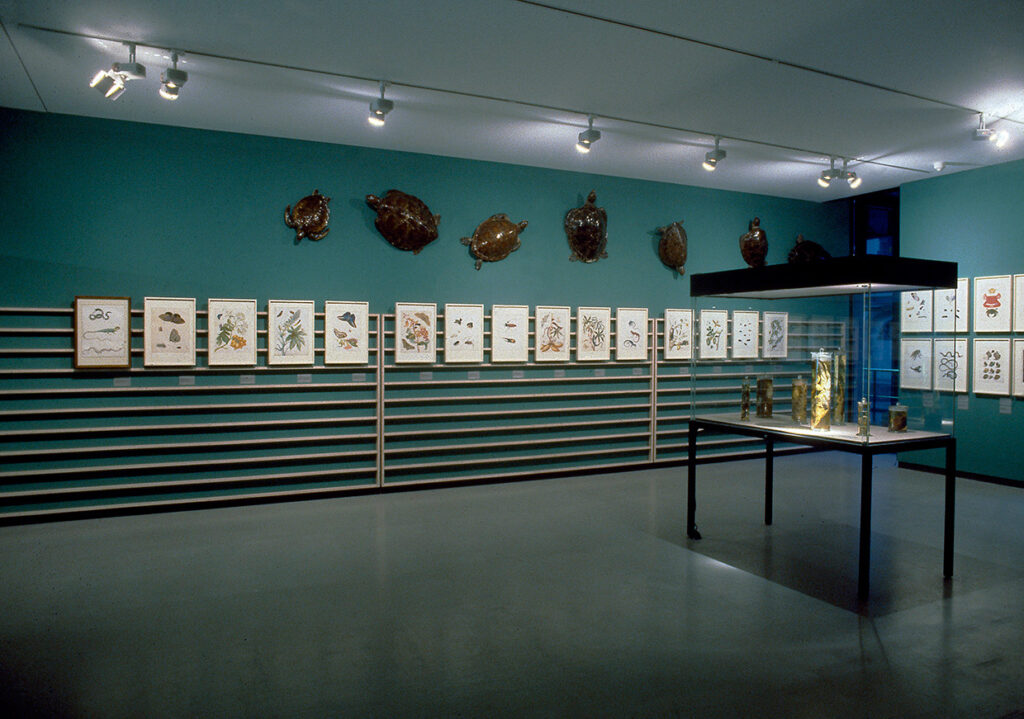
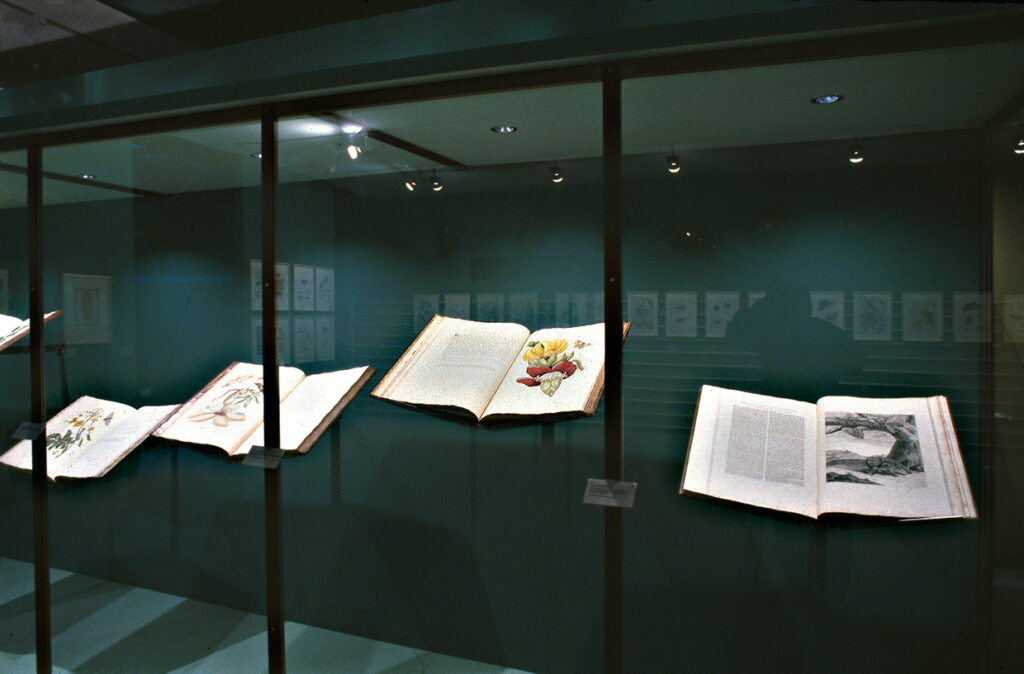
he Historisches Museum in Frankfurt am Main welcomed the 350th anniversary of Maria Sibylla Merian’s birth in 1997 as an opportunity to present a comprehensive exhibition on the work of this noteworthy artist and naturalist (Figs. 1-2). Following the completion of the Frankfurt showing in the winter of 1997/98 the exhibition moved on to the Teylers Museum in Haarlem. Some hundred parchment water-colours, the unique Studienbuch and Merian’s exceptionally rare, hand-coloured copper engravings – the early Blumenbuch, the Raupenbuch and her large-format Metamorphosis – formed the focal points of the presentation. Many of the beautiful watercolours depicting insect metamorphoses and food plants were exhibited for the first time. Worthy of particular note among these were 43 watercolours from the St. Petersburg Archives of the Academy of Sciences, which were acquired by Tsar Peter the Great along with other works by the artist in early 1717.
The exhibition was structured according to the successive phases of Maria Sibylla Merian’s life. Its chronological and topographical sequence covered a variety of thematic aspects of particular relevance to her oeuvre. At the same time, an effort had been made to place Merian’s work within the context of the history of natural science in the seventeenth and eighteenth centuries – as represented by the scientific works of other artists and naturalists, insect and floral still-lifes by Dutch women painters and preserved animal specimens, like reptiles and butterflies from Johann Christian Gerning, an important collector, whose collection is in Wiesbaden nowadays (a collection Joos van de Plas worked with during the last years).
There was one enormous problem, a gap that exists until today, and it has to be discussed how to handle it in the next future. Different works attributed to Maria Sibylla Merian, like watercolours or coloured engravings, are now held in many European and North American museums, libraries, archives, and private collections. There is no critical catalogue of Merian’s oeuvre. In the course of preparation and research for my exhibition in 1997 it was determined that many of these attributions to Maria Sibylla Merian are either questionable or fully unjustified. The principles used in selecting the works to be exhibited were intended to focus upon a standard of quality in Merian’s works against which other works might be compared. Nevertheless, the exhibition featured several watercolours whose acceptance as works of Maria Sibylla Merian’s is likely to be the subject of considerable discussion and controversy. But this, too, was one of the exhibition’s objectives: Distributed among a number of different cities and collections and never before exhibited together, the drawings, paintings, prints and books presented here offered an excellent opportunity for comparative evaluation. However, that evaluation has still to be done until today.
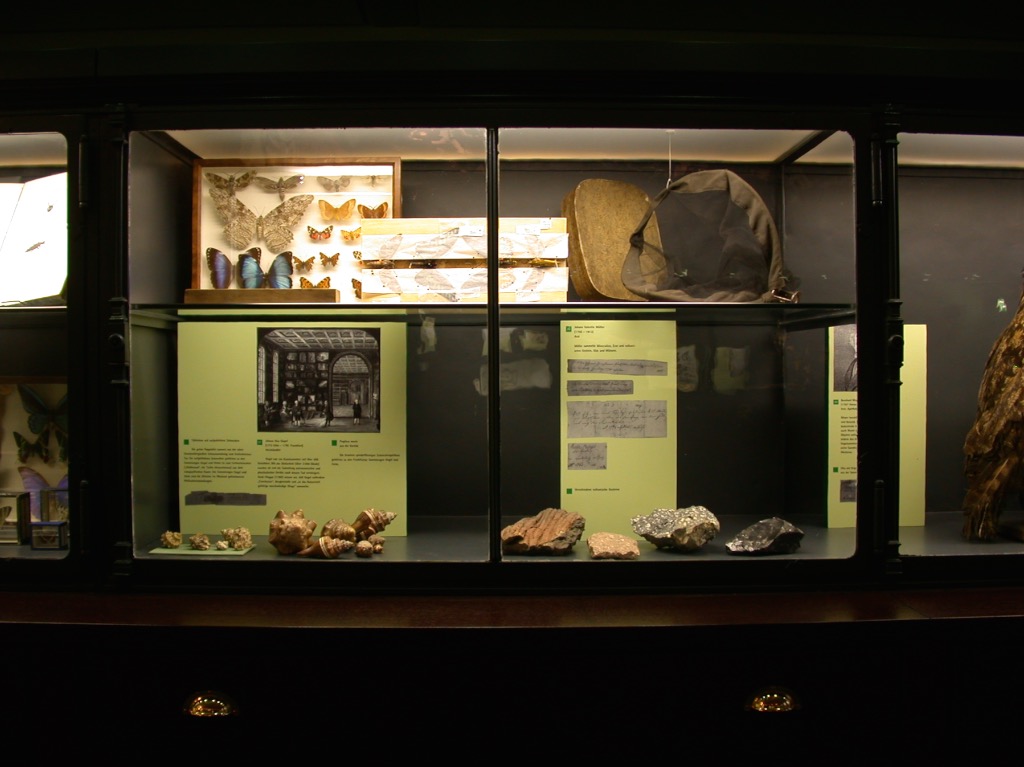
In 2003 I had the opportunity to curate a permanent exhibition in the Senckenberg Museum in Frankfurt am Main, a world-wide leading Museum for Natural History and a Center for Biodiversity. The exhibition has the title: “From natural history to natural science. Maria Sibylla Merian and the natural cabinets in Frankfurt in the 18th century”. The focus was the work of Merian as far as it could be represented by her work in the collection of the Senckenberg Museum and Library on one hand and the private collections – like Gerning and others – in Frankfurt on the other hand. The invitation of an art historian by this institution is one of the signs of a fundamental change in the theoretical approaches to science that have become increasingly apparent during the last decades of the twentieth century. Among the most noteworthy features of this process of reassessment is a critical re-appraisal of the traditionally predominant distinction between scientific knowledge and other forms of knowledge – the phenomenology of nature on the one hand, and aesthetics, on the other hand, natural history here, art history here or art on the one hand or knowledge of art history on the one hand and knowledge of artists on the other.
In 2008 Ella Reitsma curated an exhibition in Amsterdam, supported by the entomologist Sandrine Ulenberg, titled: “Maria Sibylla Merian & daughters”. The exhibition – afterwards shown in the Getty Museum – was structured according to the successive phases of Maria Sibylla Merian’s life, like our exhibition in 1997. It was already in 1997 that I stressed that a look at contemporary approaches to the relationship between art and science may be of help to us to understand and assess both Maria Sibylla Merian’s work as an artist-naturalist and the unity of art and science that still existed, at least as a potential, in the seventeenth century. This bond was severed during the eighteenth century, as natural history gave way to natural science. After the avant-garde-artist Marcel Duchamp, many artists since the 1960s did investigations into the relationship between art and science and art and nature. Worthy of note in this connection are Hans Haacke’s “real time systems” of the 1970s or the artist Paul Armand Gette, who was an artist and a trained zoologist. Since the nineties installations dealing with nature attracted attention at many exhibitions. And today there are a lot of artists dealing with biology and art, some of them are both artists and biologists, or they were trained in biology.
It should be discussed in this conference [from now on?] how knowledge about Maria Sibylla Merian’s working process and work could be improved and that means of course: it should be considered how it could be managed to make a critical catalogue. Of course – in my opinion – this is a work of collaboration. A collaboration across the borders and limitations of the sciences: a collective work of biology and botany, ethnology, history, history of the natural sciences and art history. And: including knowledge of artists like Joos van de Plas or others like Marc Dion etc. And also: including the enormous knowledge of filmmakers like Jo Francis and John Fuegi from Kopenhagen. Such a catalogue raisonné in progress as collective work could be published on a world-wide-web platform. My hope for the forthcoming conference: Let us find a new way to explore Merian’s work – the artworks themselves and of course the context she was working in.
* This text follows the introduction of the author, in: Kurt Wettengl (Ed.): Maria Sibylla (1647 – 1717) Merian. Artist and Naturalist, Ostfildern 1998 (Hatje, Thames/Hudson).