While preparing the symposium “Exploring Maria Sibylla Merian” with Kay Etheridge, Florence Pieters, and Diny Winthagen, I came across three interesting ‘Merian puzzles’.1 I briefly touched upon them in my introductory talk, and in this short essay I would like to speculate a bit on possible answers, partly based on new evidence.
In 2012 John Fuegi and Jo Francis – working together on a Merian documentary for several years – asked me if I, a book historian, could find information on the publishing date of Rupsen because they had serious doubts about Pfeiffer’s dates.2 Max Adolf Pfeiffer published his renowned bibliography of the works of Maria Sibylla Merian in 1931.3
Rupsen was published in three undated parts. According to Pfeiffer the first part was published in 1713, the second in 1714 and the third in 1717. Pfeiffer based his assumptions on rather logical arguments, quoting Merian’s ‘Vorrede’ of Raupen (1679) as stating that she had studied the metamorphosis of the caterpillar for five years.4 Thus Pfeiffer concludes that Merian started working on the caterpillars in 1674. In the “Voorreden” of Rupsen part one she mentions that she persisted in this research for 39 years. By Pfeiffer’s calculations this would mean that the first part of Rupsen was printed in 1713. The third part was published posthumously by Merian’s daughter Dorothea. In the preface she writes that due to the fact that her mother was ill for two years, Maria Sibylla was unable to finish her work. Dorothea did that for her after her mother died on 13 January 1717. Pfeiffer concludes that the third part was therefore published in 1717 but would have been published two years earlier, in 1715, had Merian been well enough to finish it. This leaves 1714 for the second part of Rupsen. Well, the reasoning is logical, but not waterproof. If we for instance take a close look at what Merian actually writes in her preface of Raupen, we read the following: “[…] many caterpillars or worms turn into flies or mosquitos which to my knowledge does not happen with the silkworms: as I continued to observe these insects into the fifth year and discovered wonderful changes, all of which I kept in a case and showed to anyone wishing to see them.”5 Pfeiffer’s conclusion is not impossible: Merian could have been working for only five years on the caterpillars, but it does not literally say so. Be that as it may: all library catalogues follow Pfeiffer.
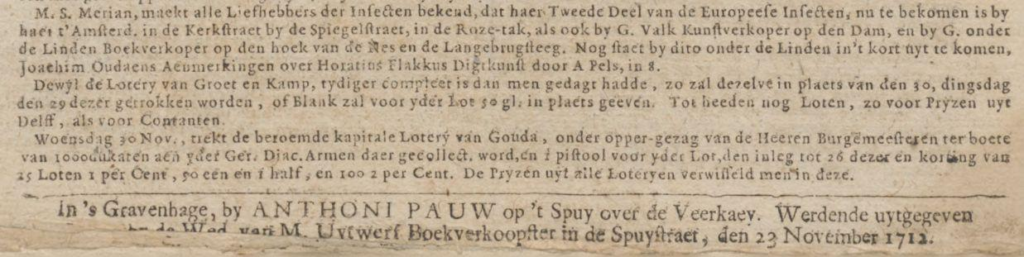
Trying to resolve this puzzle, I was lucky. The Koninklijke Bibliotheek in The Hague initiated the digitization of Dutch periodicals in 2006, and incorporated all Dutch historical newspapers. The results are currently accessible under the name ‘Delpher’.6 Although the problem with optical character recognition (OCR) remains (one simply cannot be sure that all the text on the image was transcribed correctly into computer readable text), this website is a fantastic research tool. A quick search for ‘Merian’ in the advertisements between 1690 and 1718 resulted in eight hits, six of them referring to Maria Sibylla Merian and two to her father, Matthaeus Merian.7 Five mention the Surinaemsche Insecten, but only one of the ads dealt with Rupsen. In the ‘s-Gravenhaegse Courant of 23 November 1712 we read that M.S. Merian announces that the second part of her European Insects is now available at her house in the Kerkckstraet close to the Spiegelstraet in the Roze-Tak. Moreover it is also available at G. Valk, Art Salesman on the Dam and G. Onder de Linden, Book salesman on the corner of the Nes and The Langebrugsteeg.8 An extended search (Valk, Spiegelstraat, insect, rups, roze-tak in various spellings) resulted in one more ad in the Oprechte Haerlemsche Courant 31 May 1712 in which Merian not only mentions that the second part of the changes of insects is for sale at her house, but also “English salt”, or Epsom salt, which was used for medicinal purposes.9 This information moves up Pfeiffer’s dating of 1714 by two years.
And one might expect that part one of Rupsen would have been printed earlier, in or before 1712.
Because the years 1706 through 1711 of the Amsterdamse Courant are not yet digitally accessible, John Fuegi and I went to the Amsterdam City Archives. It took us days to work through the microfiches of the Amsterdamse Courant. We did get a couple of extra Merian hits, but none shed new light on the matter.
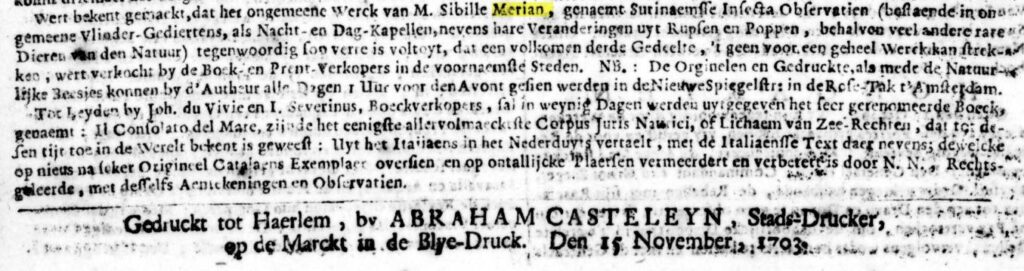
The year in which Merian’s Surinam Book was published is no puzzle at all because it is dated (1705). But in my ‘digital quest’ I noticed a very interesting ad about the making of the Surinam book. On 15 November 1703 the Oprechte Haerlemsche Courant mentions that “… the uncommon work of M. Sibille Merian, named Surinaemsse Insecta Observatien (with unusual butterflies …, and their metamorphosis from caterpillars and pupae …) at this moment has been completed so far that a complete third part, that can pass for a complete book, is for sale at the book and print sellers in the most distinguished cities …”.10
So, we now have evidence that by November 1703 Merian had a third part of her Surinam book ready for sale. This is earlier then we know from the literature. The ad in the Haerlem newspaper indicates that she sold her work in parts, probably to raise money for the completion of the book.
Also interesting is the Nota Bene with which the ad ends. It reads in translation: “The originals and the prints, as well as the animals themselves can be viewed every day, one hour before the evening, at the author’s [house] in the Nieuwe Spiegelstraat in the Rose-Tak in Amsterdam”.11
Going through the ‘s-Gravenhaegse and Oprechte Haerlemsche Courant in great detail seems for Merian researchers not the most obvious thing to do; it is extremely time consuming and after all, why would Merian herself have placed these ads in those newspapers and not in the Amsterdam newspapers? It must have had something to do with the expected clientele. As far as I know this question is still open for further research.
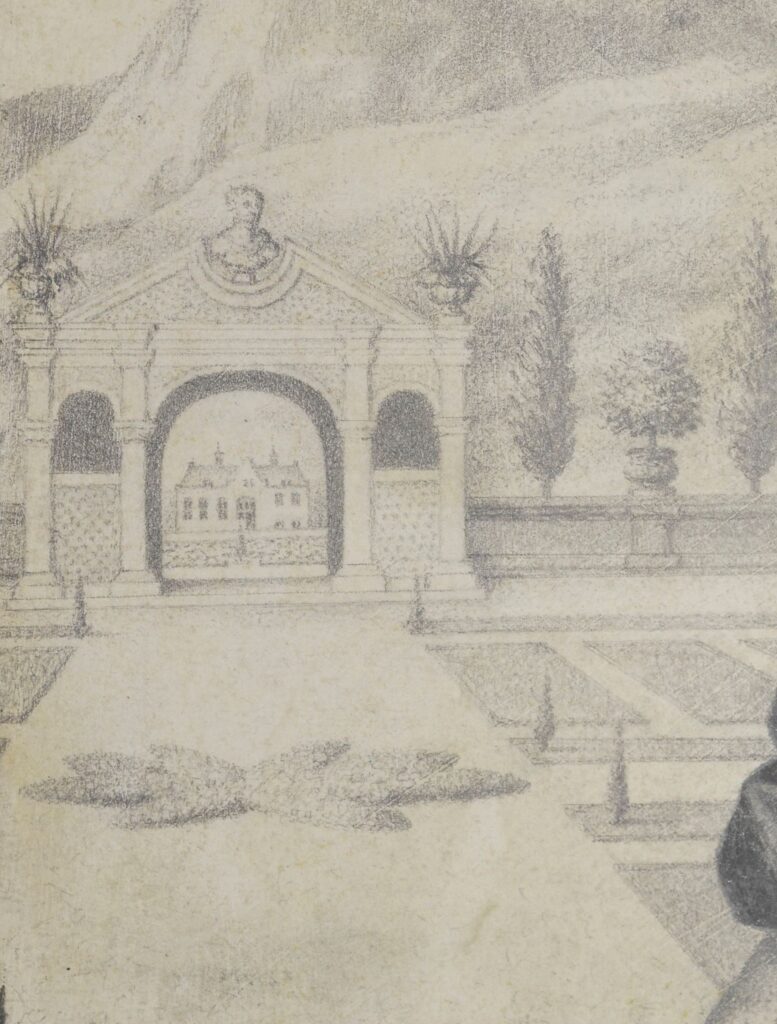
The third puzzle deals with an undated Thopas portrait, supposedly of Merian, kept by the Dutch Entomological Society, and up until recently located in the Artis Library. The drawing (plumbago, black wash on vellum) depicts a seated, elegantly dressed elderly woman. The fabric of her dress shines like silk. She wears a small black cap and in her left hand she holds a rose. To her right we see a small table with a vase and flowers and in front of the vase a small book. To her left there is a balustrade, giving the impression that the woman sits close to a balcony, which has a beautiful view on a rather exotic garden with a spacious road leading to a Roman gate set against a background of mountains. Through the gate a large mansion is visible. When we zoom in on the top level of the balustrade we can read ÆTA and a somewhat blurry figure: 59 or 79. It looks as if someone tried to erase or correct it. Merian’s name is written on the back of this picture. But is this woman indeed Maria Sibylla Merian, as for example Stuldreher-Nienhuis suggested?12 I am not the first who has serious doubts about that assumption.13
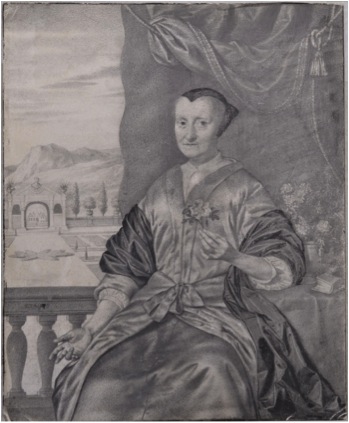
Let us have a look at the facts. Johannes Thopas was born in Arnhem around 1626 and died between 1688 and 1695.14 Thopas was a deaf mute, born in a well-to-do family. He was taken care of by his mother, brothers and sisters all his life. Thopas worked in Utrecht, Haarlem, Amsterdam and Assendelft. From his oeuvre one painting and sixty-six lead pencil drawing (plumbago’s) have survived the ages. Many of those drawings were on display at the Thopas exhibition at the Rembrandt House Museum in 2014. Rudi Ekkart wrote the catalogue that accompanied the exhibition. Ekkart’s exemplary research presents us with all known facts about the life and works of Thopas. Catalogue number 53 is titled: Portrait of a woman, erroneously called Maria Sibylla Merian, 1679(?).15 Ekkart does not tell us why this is not Merian’s portrait, but the question mark is understandable: 1679 is doubtful. ÆTA can be read as an abbreviation of Aetas (age or in the age of). It is more likely that 59 or 79, refers to the age of the portrayed woman or possibly to the artist.
After a stay of nearly six years in the Labadist settlement in Wieuwerd (Friesland), Merian came to live in Amsterdam in 1691. When for argument’s sake we take the latest possible death date of Thopas (1695) and then look at the dates, this picture, if of Merian and drawn from life (as one might expect), must have been made between 1685 and 1691 (Wiewerd) or 1691 and 1695 (Amsterdam). When we try to bring the dates into concordance with the ages of 59 or 79 we have a problem. Thopas was 59 in 1685, the year when Merian came to Wieuwerd, aged 38. And Merian was 59 in 1706, too late for Thopas. The other possible figure could be 79 and that causes another problem, because if Thopas died in 1695 he would have been 69.16 And Merian died in 1717 also in the age of 69. For this to be a picture of Merian, we must assume that the drawing was made in 1685 or 1686 by a 59-year-old Thopas of a 38-year-old Maria Sibylla Merian (she then certainly must have aged very young). The garden, the gate and the house in the background would then be the Waltha mansion, the home of the Labadist settlement in Wieuwerd, and an artist’s impression as well, because it shows no resemblance to the known picture of ‘Waltha-state’ drawn by Johann Graff, Merian’s husband at the time.17
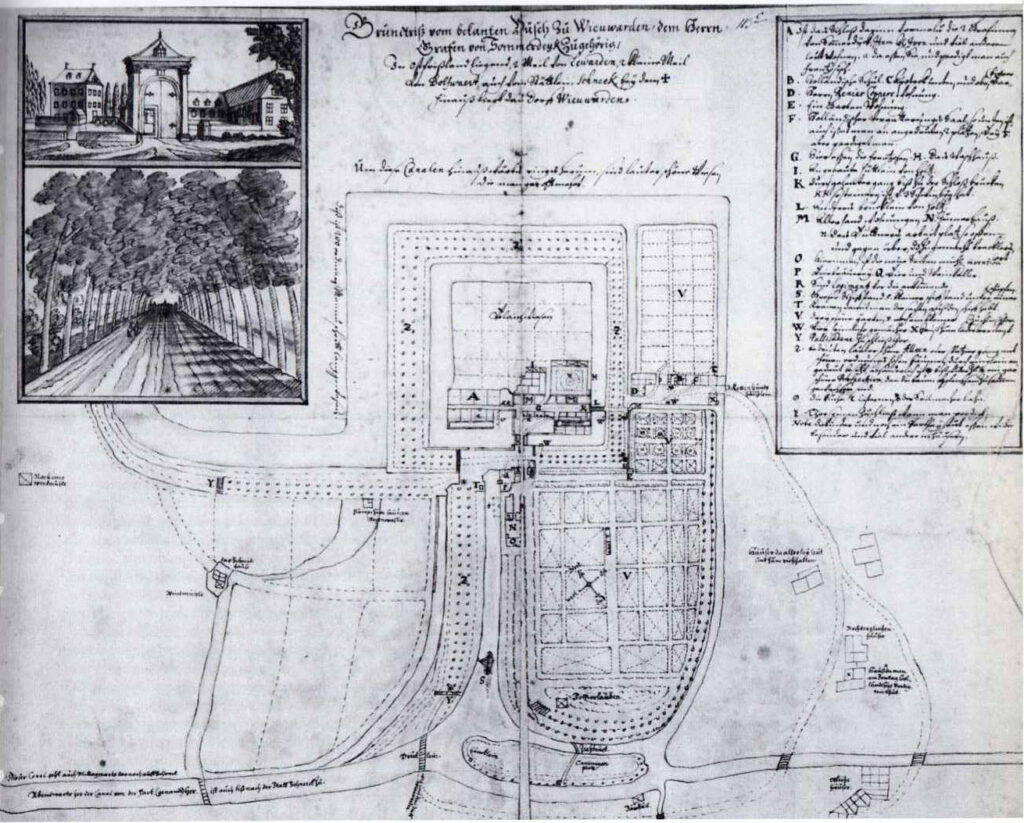
But there are other arguments against this being Merian, for instance: why is there no reference to her work (only a flower in her hand and in a vase, but no insects)? Why would Merian pose in a beautiful and costly dress, when she just entered the Labadist community, which demanded a renunciation of all earthly possessions?
Ella Reitsma has suggested that the drawing shows Agnes Block and I tend to agree.18 Agnes Block was born 1629 in Emmerich (briefly the hometown of Thopas as well) and died in Amsterdam in 1704.19 Although she lived in Amsterdam, she and her second husband, Sybrand the Flines, owned a large mansion on the river Vecht called Vijverhof. Here Agnes did a lot of important botanical work, and her garden was visited by many, among them Maria Sibylla Merian. The large painting of Agnes Block and her husband by Pieter Weenix in 1694 shows a woman bearing resemblance to the one depicted by Thopas.20 Interestingly in the background of the Weenix painting we see a Roman gate. The mansion on the Thopas drawings could be Vijverhof, and if we add the fact that Agnes Block was 59 in 1688, we can make a strong case for her to be the woman in the Thopas drawing.
Ella Reitsma has suggested that the drawing shows Agnes Block and I tend to agree. Agnes Block was born 1629 in Emmerich (briefly the hometown of Thopas as well) and died in Amsterdam in 1704. Although she lived in Amsterdam, she and her second husband, Sybrand the Flines, owned a large mansion on the river Vecht called Vijverhof. Here Agnes did a lot of important botanical work, and her garden was visited by many, among them Maria Sibylla Merian. The large painting of Agnes Block and her husband by Pieter Weenix in 1694 shows a woman bearing resemblance to the one depicted by Thopas. Interestingly in the background of the Weenix painting we see a Roman gate. The mansion on the Thopas drawings could be Vijverhof, and if we add the fact that Agnes Block was 59 in 1688, we can make a strong case for her to be the woman in the Thopas drawing.
There remains a lot to be discovered about Maria Sibylla Merian. Just more or less accidentally trying to solve three Merian puzzles, I raised a few new ones already, for instance the one about why Merian would have put advertisements in the The Hague en Haarlem newspapers and not in the Amsterdamse courant. But there still are many, many more questions. Merian is of interest for entomologist, botanists and historians from different disciplines (science, art, politics, economy, religion and the book), all the more reason for a grand conference. The newly founded M.S. Merian Society will do its utmost to bring all those researchers to Amsterdam in 2017. I hope that combining our forces will help us to better understand Merian’s life and work. And because the study of Merian includes so many research fields it should be possible to paint a more complete picture of the western world in the late seventeenth and early eighteenth century.
- Exploring Maria Sibylla Merian, Symposium held in the Artis Library (University of Amsterdam), Amsterdam 26 – 28 May 2014). ↩︎
- Merian, Maria Sibylla, Der rupsen begin, voedzel en wonderbaare verandering … Naauwkeurig onderzogt, na ’t leven geschildert, in print gebragt, en in ’t kort beschreven (Amsterdam, 1713-1717). ↩︎
- Pfeiffer, Max Adolf, Die Werke der Maria Sibylle Merian (Meissen, Dudelsackpresse, 1931). ↩︎
- Merian, Maria Sibylla, Der Raupen wunderbare Verwandelung, und sonderbare Blumen-nahrung, worinnen, durch eine gantz-neue Erfindung…, (Nürnberg / Frankfurt, 1679), p. iii. ↩︎
- […] aus manchen Raupen oder Würmern gar Fliegen / oder Mucken werden ; dergleichen mit den Seidenwürmeren / meines Wissens / nicht geschicht : Wie ich dann bis in das fünfte Jahr hero denselbigen stets abgewartet / und wunderbarliche Veränderungen erfahren ; solches auch für jedesmanniglich der es zu sehen verlangte in einer Schachtel aufbehalten / und gewiesen. ↩︎
- http://kranten.delpher.nl/nl/. ↩︎
- Merian started working in Amsterdam in 1691 and died there in 1717. ↩︎
- M.S. Merian maekt alle Liefhebbers der Insecten bekend, dat haer Tweede Deel van de Europeese Insecten, nu te bekomen is by haer ’t Amsterd. in de Kerkstraet by de Spiegelstraet, in de Roze-Tak, als ook by G. Valck Kunstverkoper op den Dam, en by G. onder de Linden Boekverkoper op den hoek van de Nes en de Langebrugsteeg. ↩︎
- M.S. Merian maeckt bekent aen alle Liefhebbers der Insecten, dat haer tweede Deel van de veranderinge van Insecten by haer te komen is, t’Amsterdam in de Kerckstraet by de Nieuwe Spiegelstraet in de Roosen Tack; als oock by Gerard Valck in de wekende Hont op den Dam: Sy verkoopt oock het Engels Zout, het welck plagt verkocht te werend het tweede Huys van het Wale Weeshuys, (pond) 30 Stuyvers. ↩︎
- Wert bekent gemaekt, dat het ongemeene Werck van M. Sibille Merian, genaemt Surinaemsse Insecta Observatien (bestaende in ongemeene Vlinder-Gediertens, als Nacht- en Dag-Kapellen, nevens hare Veranderingen uyt Rupsen en Poppen, behalven voor veel andere rare Dieren van den Natuur) tegenwoordig soo verre is voltoyt, dat een volkomen derde Gedeelte, ’t geen voor een geheel Werck kan strekken, wert verkocht by de Boek- en Prent-Verkopers in de voornaemste Steden. NB. : De Originelen en Gedruckte, als mede de Natuurlijke Beesjes konnen by d’Autheur alle Dagen 1 Uur voor den Avont gesien werden in de Nieuwe Spiegelstr: in de Rose-Tak t’Amsterdam. ↩︎
- See footnote 9. ↩︎
- Stuldreher-Nienhuis, J., Verborgen paradijzen : het leven en de werken van Maria Sibylla Merian 1647-1717 (Arnhem, 1945), p. 171. ↩︎
- Reitsma, Ella, Maria Sibylla Merian & daughters : women of art and science (Zwolle, 2008), p. 125 (footnote 51). ↩︎
- Rudi Ekkart, Deaf, Dumb and Brilliant: Johannes Thopas, Master Draughtsman (Amsterdam 2014). This publication accompanied the Thopas exhibition in The Rembrandt House Museum (11 July – 5 October 2014). ↩︎
- Idem, p. 129. Ekkart wrongly writes that this drawing is now being held by Leiden University Library. The collections (specimens and library) of the Dutch Entomological Society (owner of the drawing) were moved from Amsterdam to Naturalis National Biodiversity Centre, in Leiden. ↩︎
- Idem. Ekkart mentions another Johannes Thopas who also lived in Assendelft, but this was Thopas’ nephew (1655-1705) who work as a town clerk (p. 23, note 14). ↩︎
- The sketch of the ground plan of Waltha-state (1686) by Johann Andreas Graff (Neurenberg, Staatsarchiv, Rst. Nbg., Karten und Pläne, Nr. 1085), shows Waltha-state in the left upper corner. ↩︎
- Reitsma, p. 125 (footnote 51). ↩︎
- See for a short biography (in Dutch): http://resources.huygens.knaw.nl/vrouwenlexicon/lemmata/data/Block ↩︎
- Reitsma writes that this woman wears a Mennonite cap. This could be possible, but according to Adriaan Plak, keeper of the Mennonite collections of the UvA, it probably is a so called ‘tipmuts’, a cap worn by elderly women in Holland. ↩︎